Dear friend now in the dusty clockless hours of the town when the streets lie black and steaming in the wake of the watertrucks and now when the drunk and the homeless have washed up in the lee of walls in alleys or abandoned lots and cats go forth highshouldered and lean in the grim perimeters about, now in these sootblacked brick or cobbled corridors where lightwire shadows make a gothic harp of cellar doors no soul shall walk save you. (Incipit of Suttree)
Welcome to Era 1:
The Orchard Keeper (1965)
Outer Dark (1968)
Child of God (1973)
Suttree (1979)
After the youth short stories and before moving from Knoxville to El Paso around 1975, Cormac McCarthy wrote four novels, concluding with the monumental and semi-autobiographical Suttree. Despite (or because) of his wealthy upbringing—his father was a successful lawyer—he lived during that period a rather destitute life in or around Knoxville. He spent time in North Carolina and New Orleans and did two trips to Europe funded by literary grants. He married in 1961 and fathered a son in 1962 but parted with this family and remarried in 1966. He took no actual job and lived off and for writing.
Era 1 novels aren’t comfort reads. Casual readers often discover McCarthy with his most accessible books No Country for Old Men or The Road, but there’s an argument for starting in Era 1; these stories are where McCarthy comes from, where his prose is the coldest and the most baroque, and where the aesthetic shock is greatest.
To those new to McCarthy and this era I’d recommend starting with Child of God, and that’s what most McCarthy readers will tell you, but better read my notes first and see which story calls to you.
The Orchard Keeper
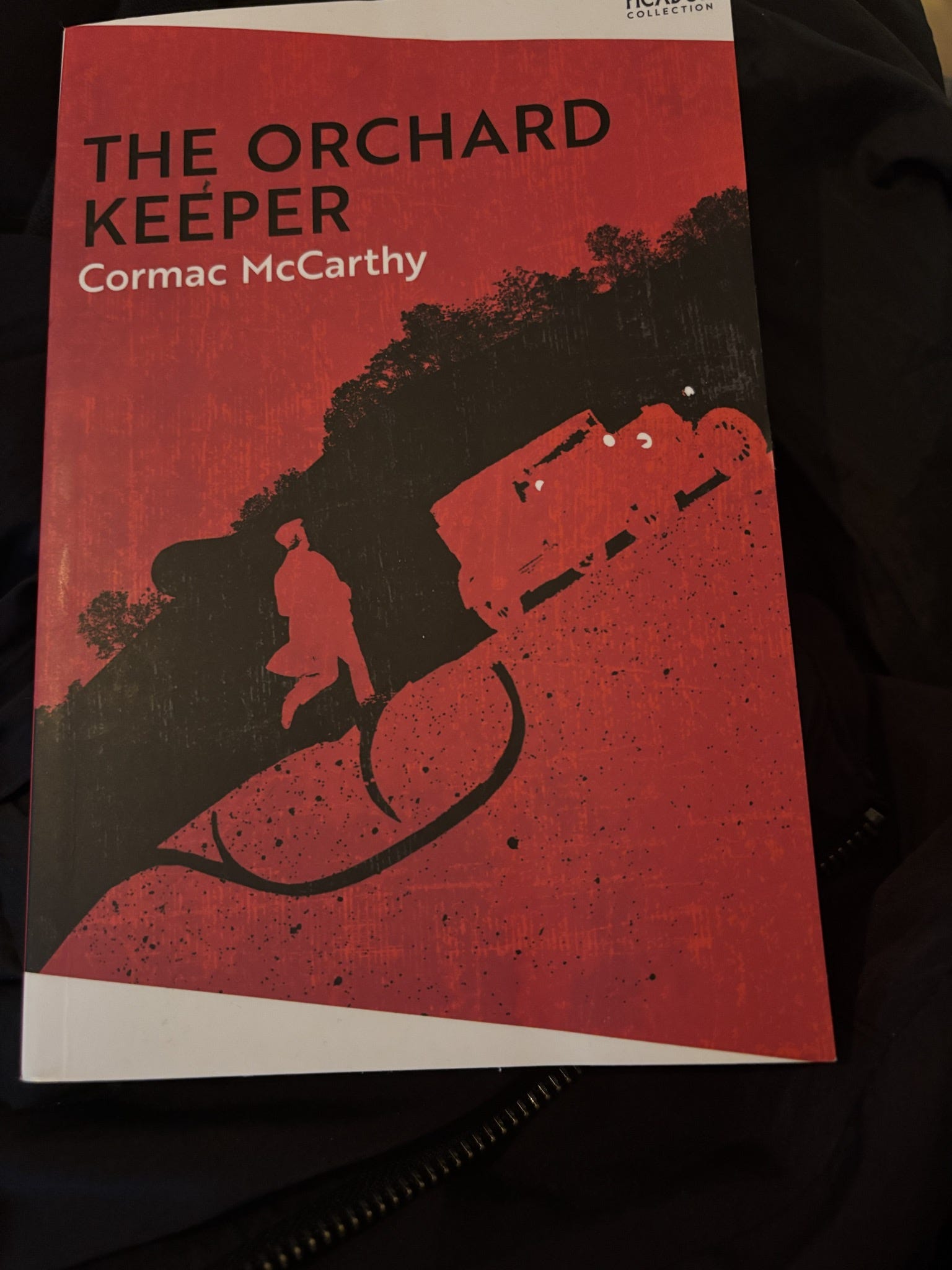
This is McCarthy’s first novel, which he started in college. It’s the least read book of his era, partly because of its sheer difficulty, and arguably because of its outwardly non-memorable plot and characters. The Orchard Keeper centers on two figures: John Wesley Rattner, a boy coming of age, and Marion Sylder, a bootlegger who unknowingly killed Rattner’s father. Their paths will cross without either knowing who the other is.
ToC won William Faulkner Foundation Award (for first notable novel), but otherwise was not praised by critics. Here’s what a the NYT wrote in 1965:
In his ‘The Orchard Keeper’ he has his own story to tell; but he tells it with so many of Faulkner’s literary devices and mannerisms that he half submerges his own talents beneath a flood of imitation.
There are no marathon sentences in these pages, most of Faulkner's other famous characteristics are present: the wandering pronouns with no visible antecedents; the recondite vocabulary and coined words; the dense prose packed with elaborate figures of speech; (…)
And indeed ToC’s prose is often trying too hard, and lacks harmony and rhythm. McCarthy hadn’t yet learned how to let his text (and reader) breathe.
The critic concludes
All these factors insure that “The Orchard Keeper” is an exasperating book. But the wonder is that in spite of them it is also an impressive book.
acknowledging that
Mr. McCarthy is expert in generating an emotional climate, in suggesting instead of in stating, in creating a long succession of brief, dramatic scenes described with flashing visual impact.
I don’t want this note to sound too harsh though, or to give a wrong impression. ToC is not McCarthy’s at his greatest, but is a very fine novel in its own right, and a literary masterpiece when compared to most “bestsellers” produced by the book industry.
PS: While rereading part of it to write this post, a chapter turned out to be identical to the short story Bounty, discussed in our previous post.
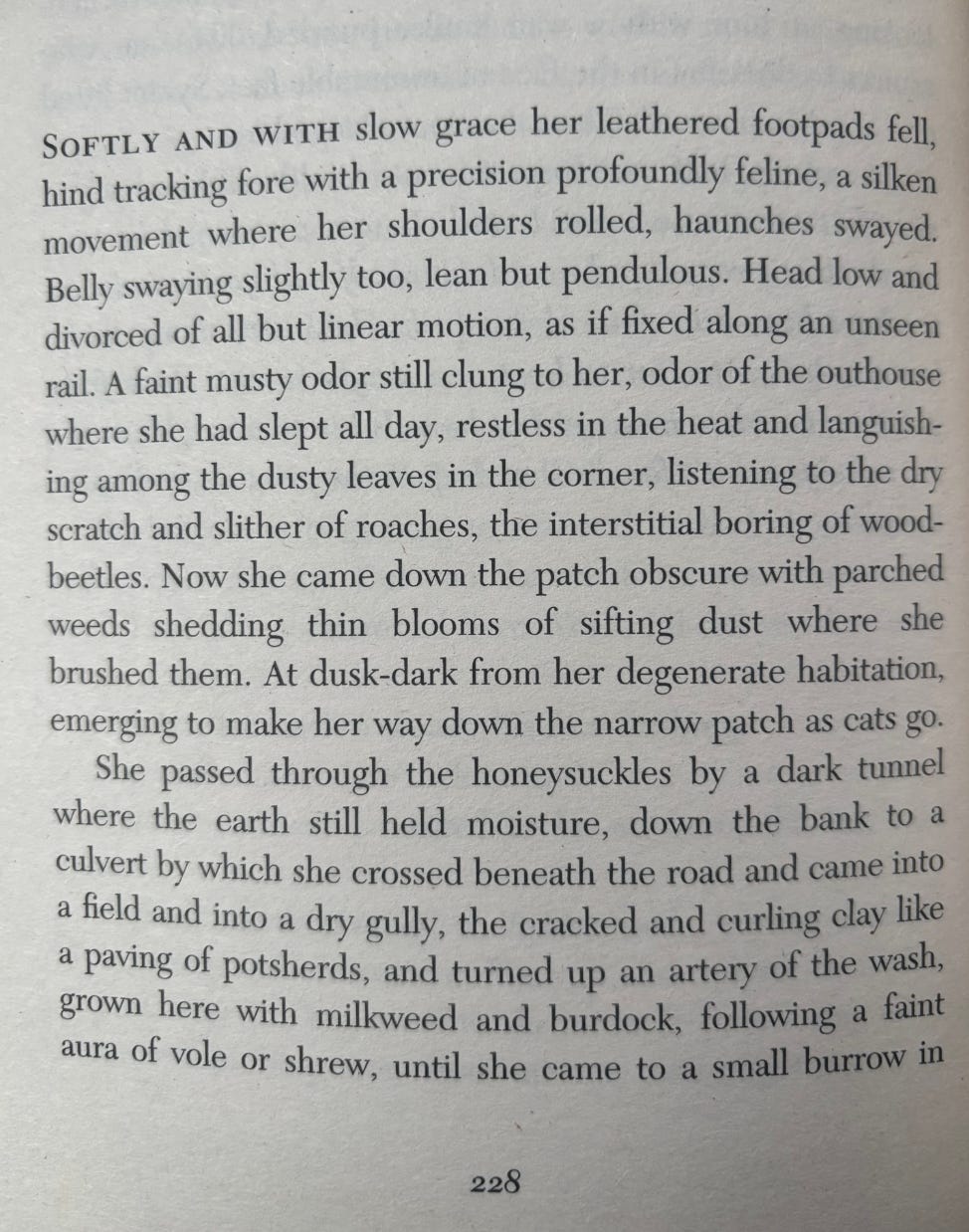
PPS: As a cat owner, I appreciated this passage:
Outer Dark
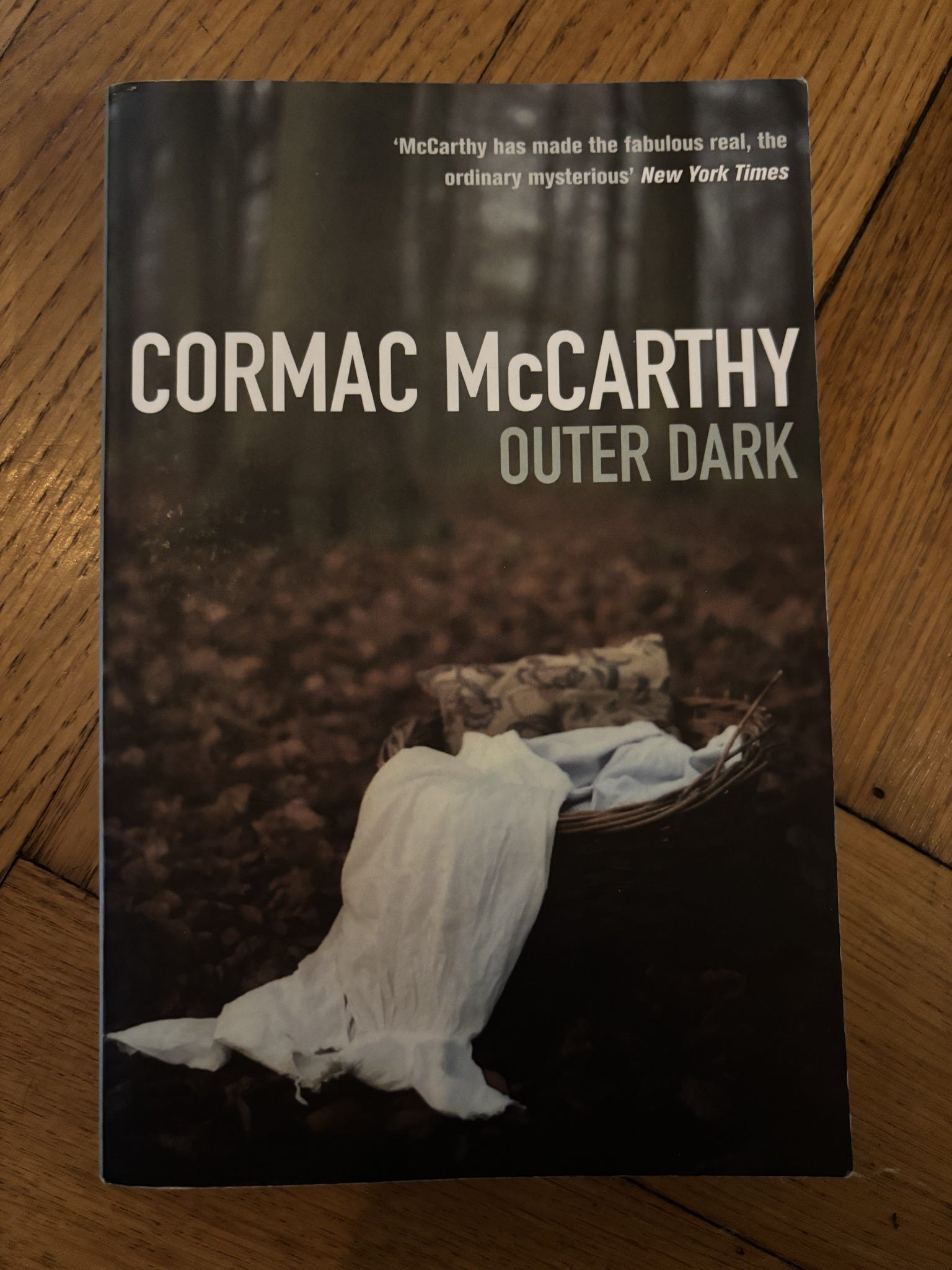
McCarthy started writing Outer Dark in Knoxville, and finished it in Ibiza, of all places. It’s my favorite in this era after Suttree: Rinthy and Culla Holme are sister and brother in the Appalachian backwoods where they have an incestuous child. Culla abandons the infant in the woods but it’s saved by an itinerant wares salesman (the Tinker), unbeknownst to Culla, who intends to hand it to a wetnurse in town.
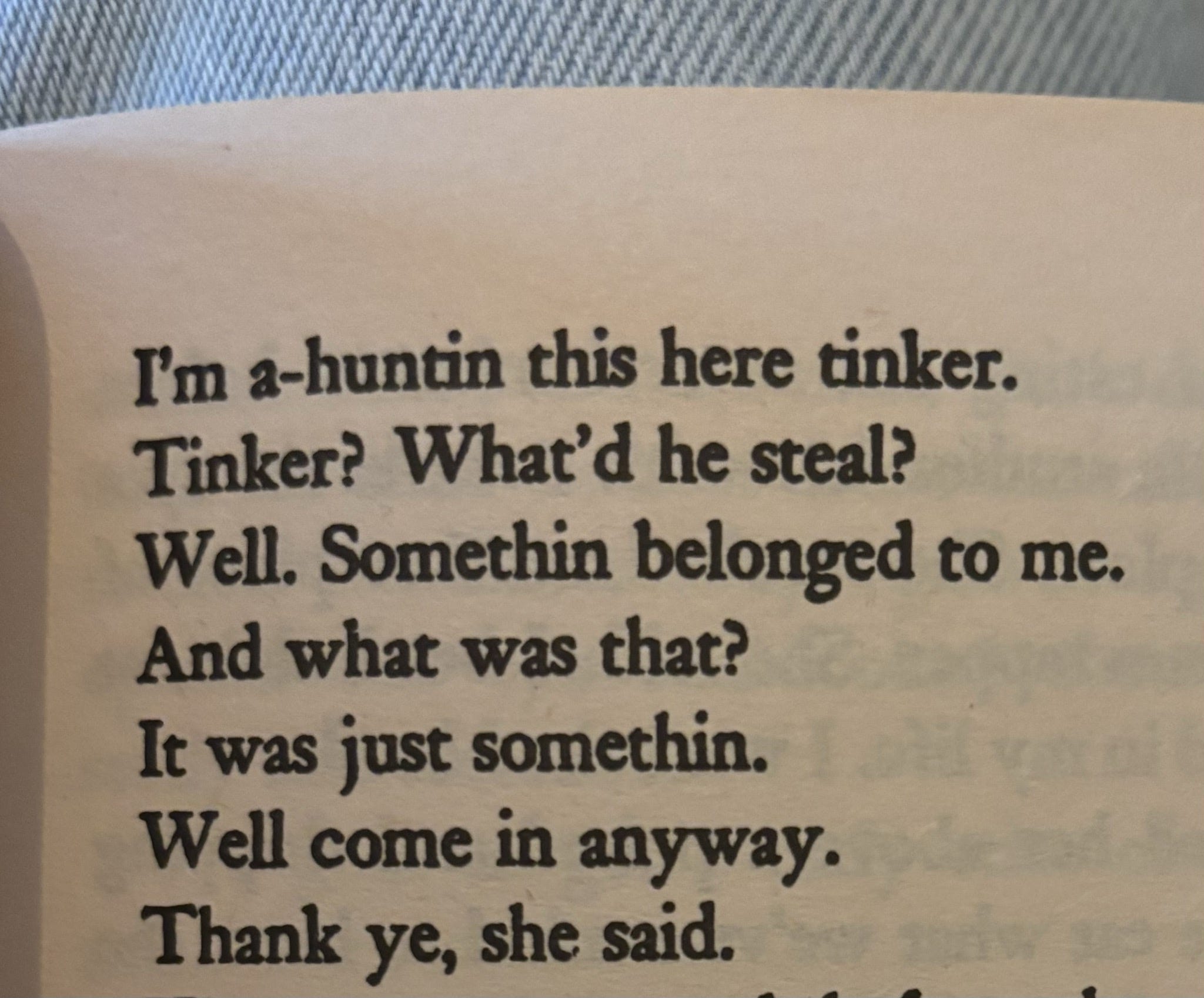
Outer Dark then follows the parallel tragicomedic journeys of Culla and his sister: his, fleeing out of guilt, seeking an occupation; hers, looking for her baby after she finds out Culla lied to her when he said the baby died. Through the towns, hamlets, and roads they pass they meet a variety of often pathetic characters, largely unnamed, including the three-headed band of men who eventually bring the search to the conclusion you’d expect from McCarthy. There are murders, desecrated graves, cannibalism, but also humour and grotesque. Like Rinthy’s recurrent “I’m a-huntin this here tinker”:
In Outer Dark, McCarthy dispenses with the overfaulknerism and opts for simpler parable-like prose that’s more fluid and lyrical than either The Orchard Keeper or Child of God. It suits the quietly oppressive and dangerous universe of the characters, and McCarthy's refusal to grant his protagonists any reflective distance from their own predicament.
Wikipedia innocently writes “Ethical considerations do not seem to exist in the world of Outer Dark, while the fates of characters are not determined by the morality of their lives.” Which is exactly what McCarthy is saying through his books if you remove “of Outer Dark” from that sentence.
Child of God
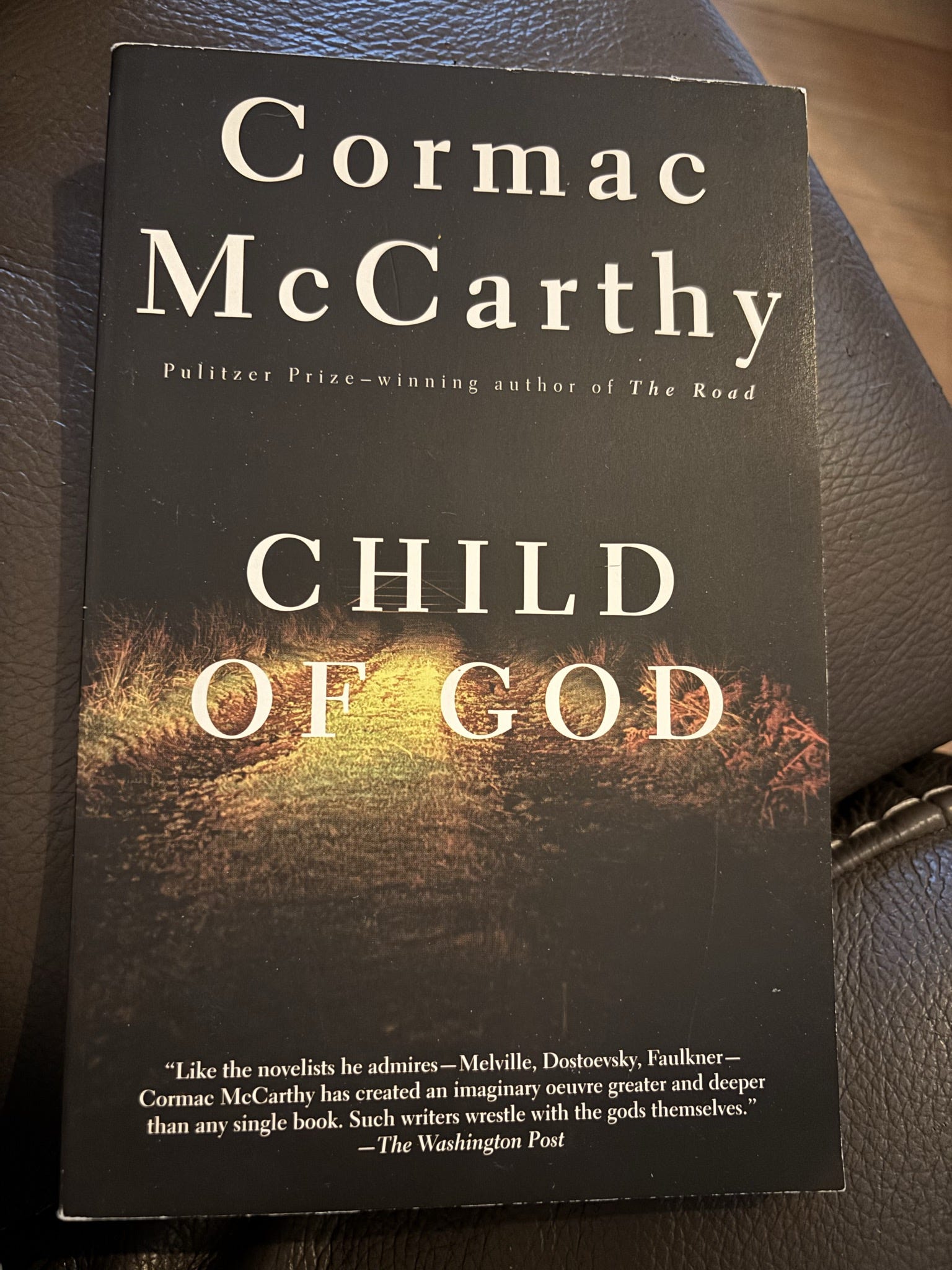
Like contemporary airport novels and Y.A. fiction, Child of God has short chapters, sometimes barely a page. But the analogy stops here:
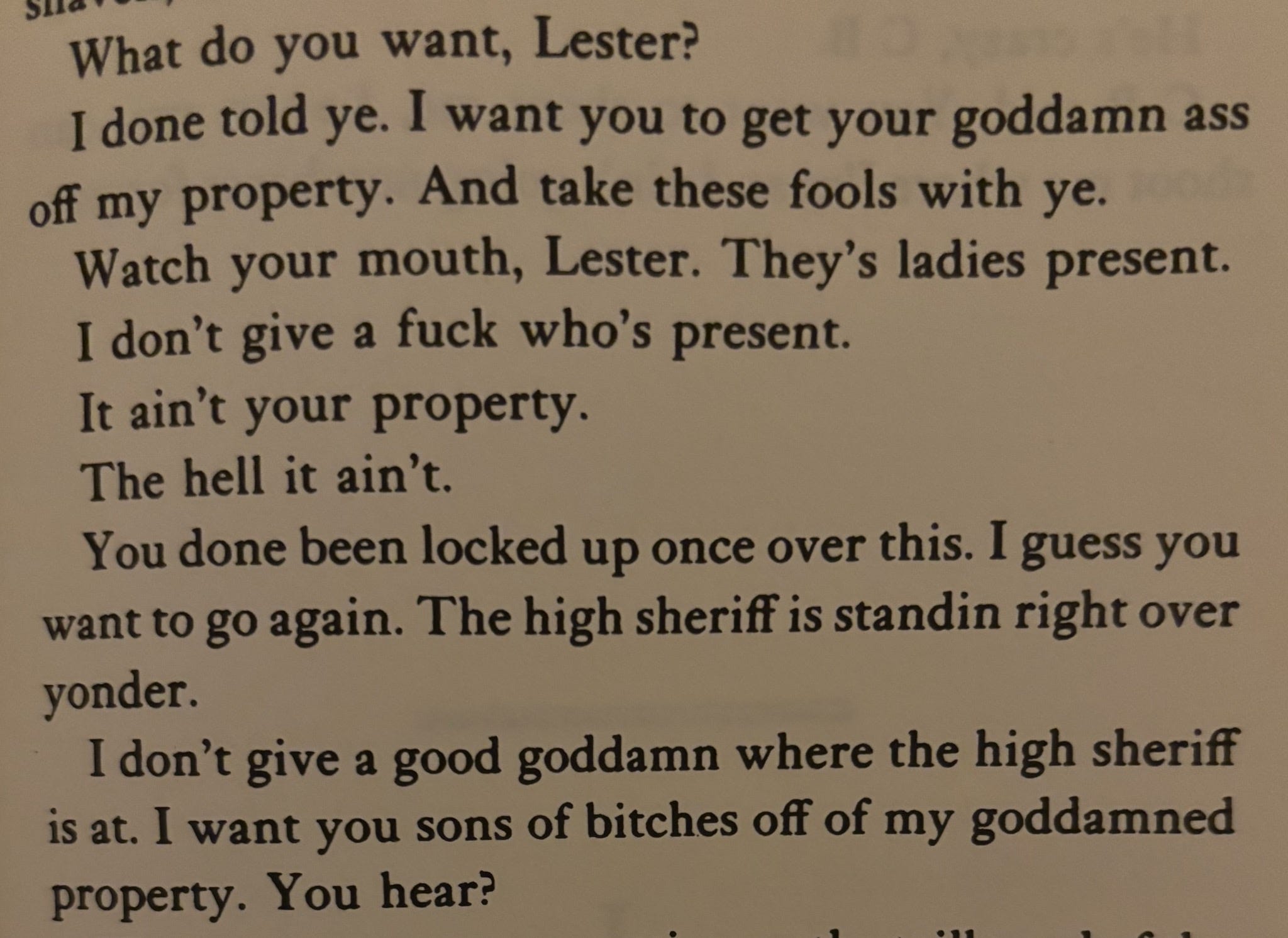
Meet Lester Ballard. “He is small, unclean, unshaven. He moves in the dry chaff among the dust and slats of sunlight with a constrained truculence. Saxon and Celtic bloods. A child of God much like yourself perhaps.”
Child of God is McCarthy's most brutal book of this era (Blood Meridian would surpass it.) It tells the amoral, brutal, murderous, necrophiliac, but not humorless story of Lester from the time he’s evicted from his home in Sevier County, South-East of Knoxville up to his demise. In the penultimate chapter, McCarthy tells us that Ballard is not a “crazy man,” implying he’s beyond even that:
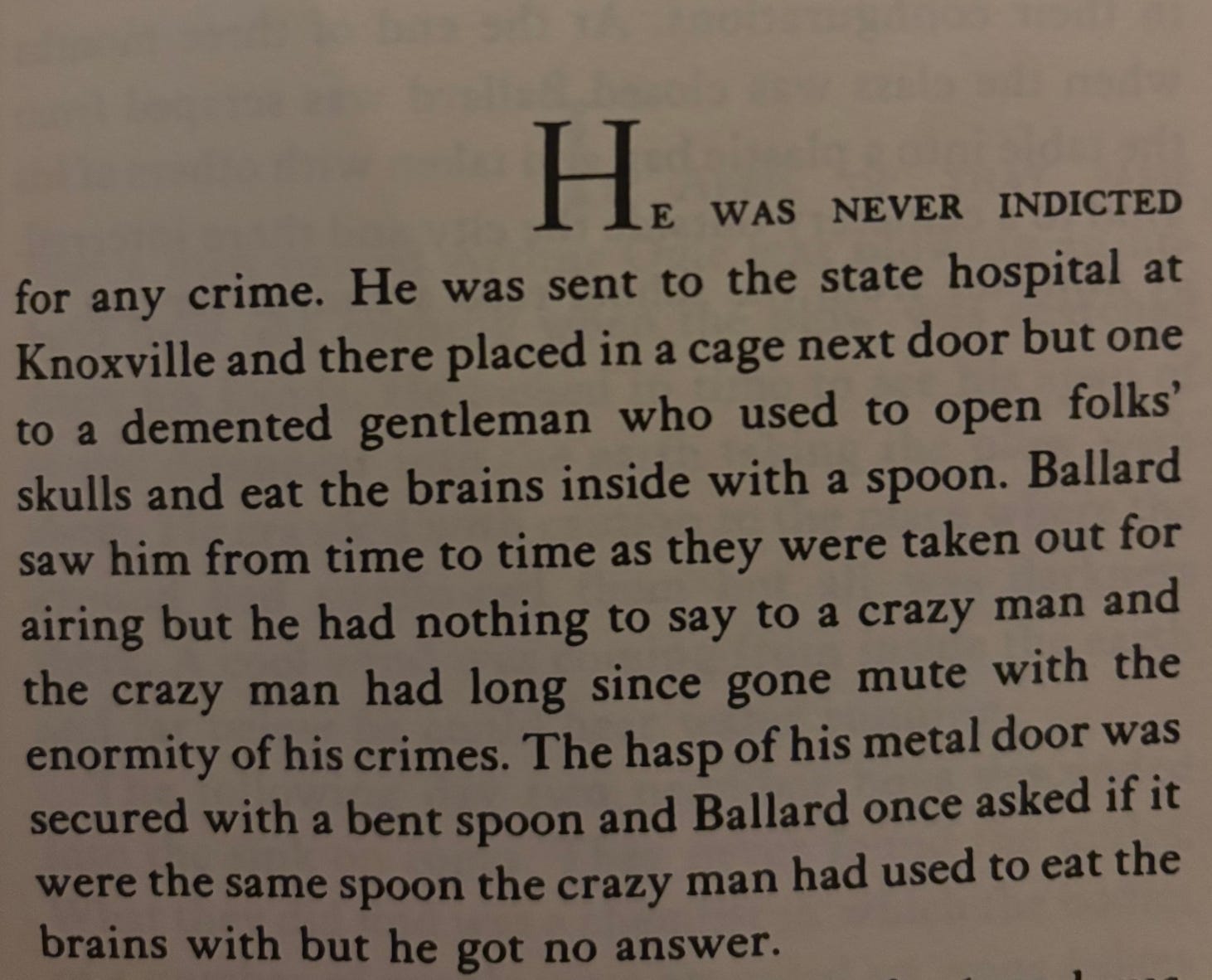
Commenters often cite Lester Ballard as a prefigure of Anton Chigurh, the villain of No Country for Old Men, for their shared gratuitous violence. But whereas Chigurh’s violence is calculated, methodical, and sadistic, Ballard’s is more primal and spontaneous. Still a neutral observer, McCarthy describes his atrocities with the same tone he uses for weather or plants.
I don’t know how I feel about CoG, to be honest. As much as I enjoyed the experience of reading it, I’ve only read it once, only going back to it to write this post. As scary as Ballard can be, he doesn’t have the depth of Chigurh, let alone that of Blood Meridian's Judge Holden. Perhaps it’s the sheer brutality not only of the story, but of the text itself that puts me off. Perhaps that was McCarthy’s goal. But perhaps I should read it again.
Suttree
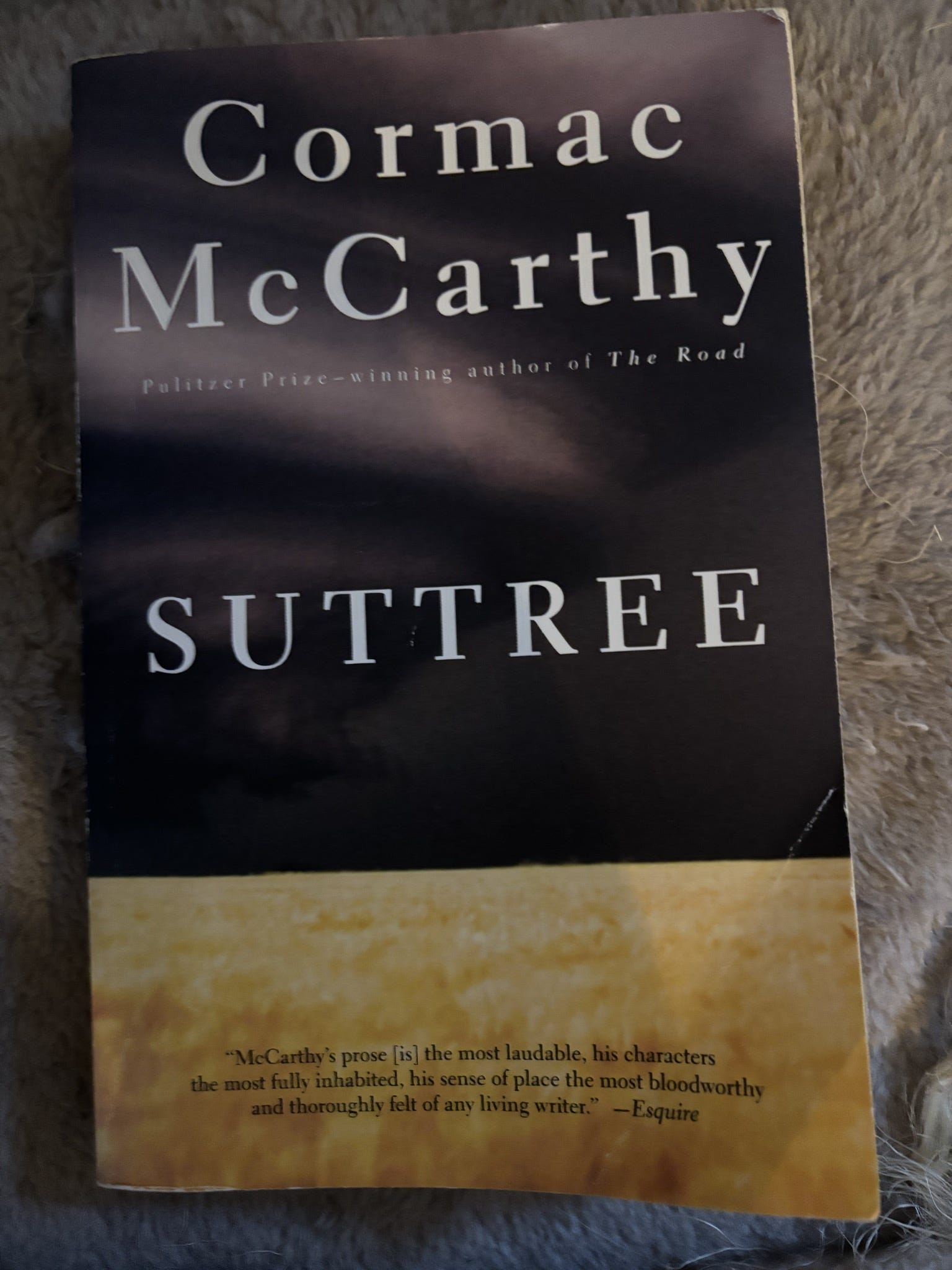
McCarthy started Suttree around 1959 when he started writing fiction and it took him around twenty years to publish it. It’s unlike any of his other books: semi-autobiographical, strongly character-centered and plotless, with as many characters as a Dostoyevsky novel (many inspired from real characters, whose graves are listed here). The 1992 NYT article Cormac McCarthy’s Venomous Fiction correctly describes the central protagonist, Cornelius Suttree, as “a sensitive and mature protagonist, unlike any other in McCarthy’s work, who ekes out a living on a houseboat, fishing in the polluted city river, in defiance of his stern, successful father. A literary conceit—part Stephen Daedalus, part Prince Hal—he is also McCarthy, the willful outcast. Many of the brawlers and drunkards in the book are his former real-life companions.”
I wrote in the introduction that McCarthy walked away from his wife and newborn son. Cornelius Suttree did too, with grimmier consequences; this is page 148 of the 1992 Vintage reedition:
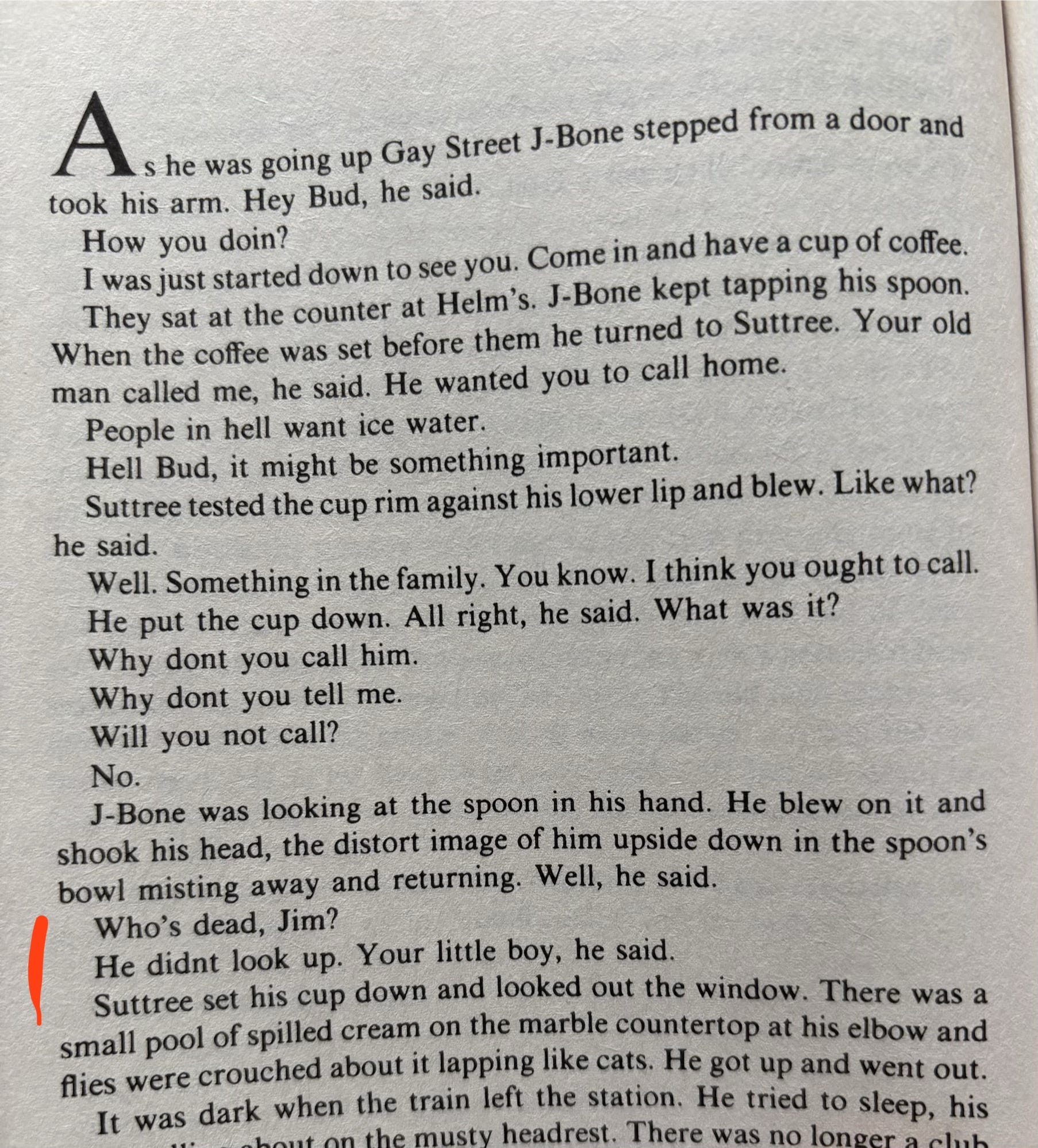
After this news Suttree takes a bus to the unnamed town where his ex lives and reminisces about the time he spent with his son:
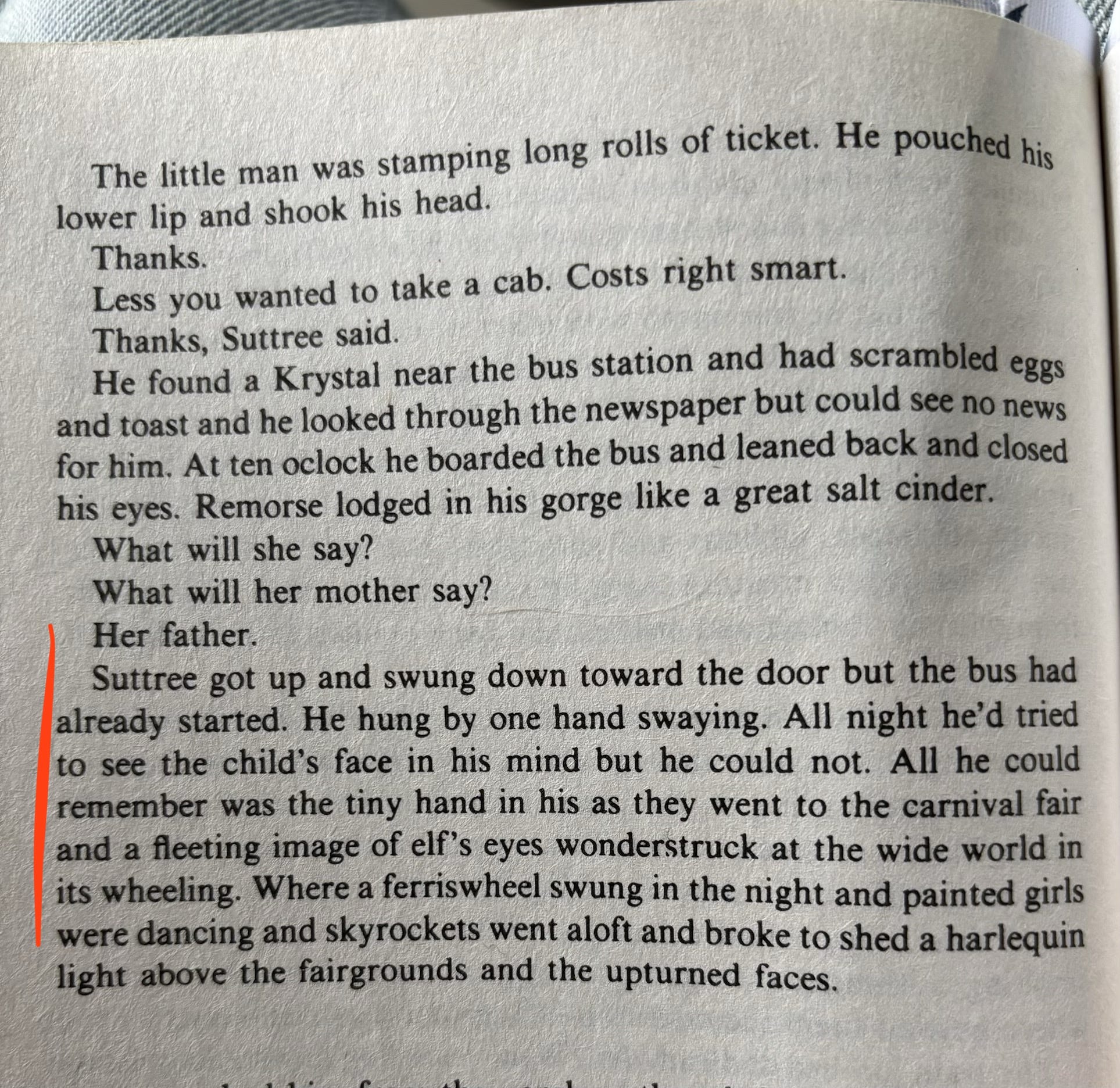
These are some of the saddest lines McCarthy ever wrote.
What first strikes you when you open Suttree is the density and entropy of his prose. It can feel overwritten, mostly due to McCarthy’s love for arcane words. For example in the incipit's continuation:
Old stone walls unplumbed by weathers, lodged in their striae fossil bones, limestone scarabs rucked in the floor of this once inland sea. Thin dark trees through yon iron palings where the dead keep their own small metropolis. Curious marble architecture, stele and obelisk and cross and little rainworn stones where names grow dim with years. Earth packed with samples of the casketmaker’s trade, the dusty bones and rotted silk, the deathwear stained with carrion.
Readers may also be confused by the point of view shifts from the main third-person to characters’ first-person PoV, another faulknerism, like the speechmarkless dialogues.
Suttree doesn’t absorb you with its darkness or archetypal figures like Child of God or Blood Meridian. The brutality is less in actions than in the stories of the picaresque characters you’ll encounter in the book. It’s closest to his penultimate novel The Passenger; both center on a middle-aged man wandering in and around his hometown where he hangs out with old acquaintances. Like The Passenger’s Bobby Western, Cornelius Suttree is a self-aware, intellectual, compassionate, begrieved man who holds himself accountable for his past actions and shies away from any nostalgia or sentimentality. Suttree (the book) is slow, contemplative, and does what every McCarthy book does—"deal with issues of life and death," in his own words—better than any other of his books, save perhaps for The Road. Suttree marks the end of McCarthy’s Knoxville era. Even before its publication he’d moved to the Southwest, where he’d write western novels.
(I’ve read Suttree relatively late, it’s one of the last McCarthy novels that I read, and I probably wouldn’t have appreciated it as much had I not been familiar with his biography and other works. Whenever you read it, I recommend that afterwards you read these analyses by literary critics.)
C'est trop noir ,trop désespéré pour moi.
Cet écrivain me dérange .Et pourtant je suis curieuse .
peut être que je vais en ouvrir un autre.....