[I first meant to do one long post with all five “eras” but ended up going for five shorter posts because #1 I’ve more to say than I first thought, #2 it takes time to go back to each era and reread parts of his work, #3 readers prefer few short pieces than a single longer once. Divide and conquer.]
Taylor Swift is the most successful pop songwriter and performer of her generation. She writes about romantic love and the tortuousness of relationships. The late Cormac McCarthy was the greatest American writer of his time. He wrote about death, violence, and evil as ambient conditions of existence. He also wrote about love and romance, though not in a way suitable to a song by Ms. Swift.
McCarthy grew up in Knoxville, Tennessee and his early books are inseparable from Tennessee’s geography and Appalachian vernacular, as Outer Dark’s dialogues reflect in phrases like “I’m a-huntin somebody” or “Mayhaps he never meant to.” At age 43 he moved to El Paso, Texas and later to Santa Fe, New Mexico, where he passed in 2023.
At age 13 Swift moved to Hendersonville, Tennessee in Nashville suburbs, a place with little in common with Knoxville except for the state. She later moved to New York and keeps a home in Nashville.

But this post isn’t about Tennessee.
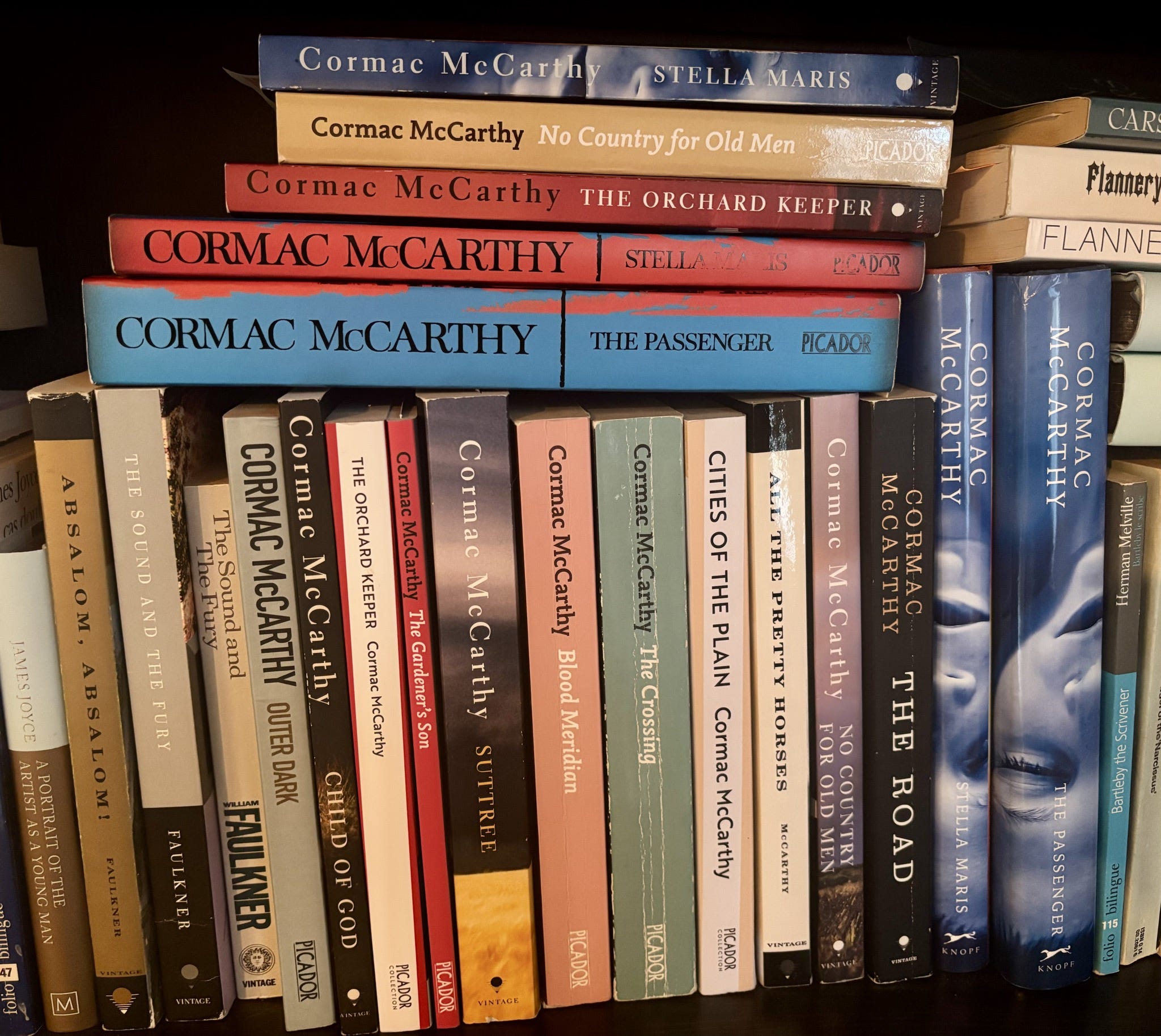
McCarthy and Swift both have distinctly delineated creative phases—eras, each with its own aesthetic, themes, locations, and emotional register. Swift’s eras are well documented but McCarthy's not as much. Having read all his novels and a large part of his other writings, I’ll give it a shot in this series of posts.
Era 0: Youth short stories
Period: 1959-1965
Books stories:
Wake for Susan (1959)
A Drowning Incident (1960)
Bounty (1965)
The Dark Waters (1965)
In 1959 McCarthy is 26 years old. He’d returned to the University of Tennessee in 1957 after serving four years in the U.S. Air Force. He published the 4-page stories Wake for Susan and A Drowning Incident in the student literary magazine The Phoenix under the name C. J. McCarthy (his full name is Charles Joseph McCarthy Jr.)
As in any writer’s first works there are self-indulgent phrases and probably too many adjectives and adverbs, but the early signs of his future novels’ themes, settings, and prose gravity are there.
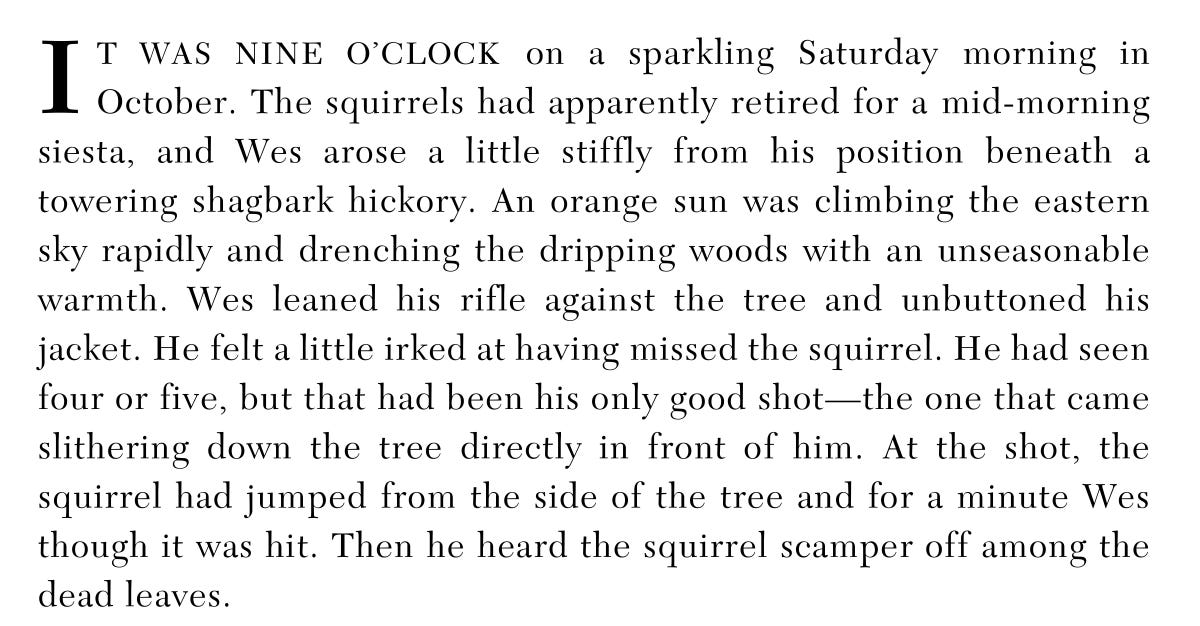
Wake for Susan
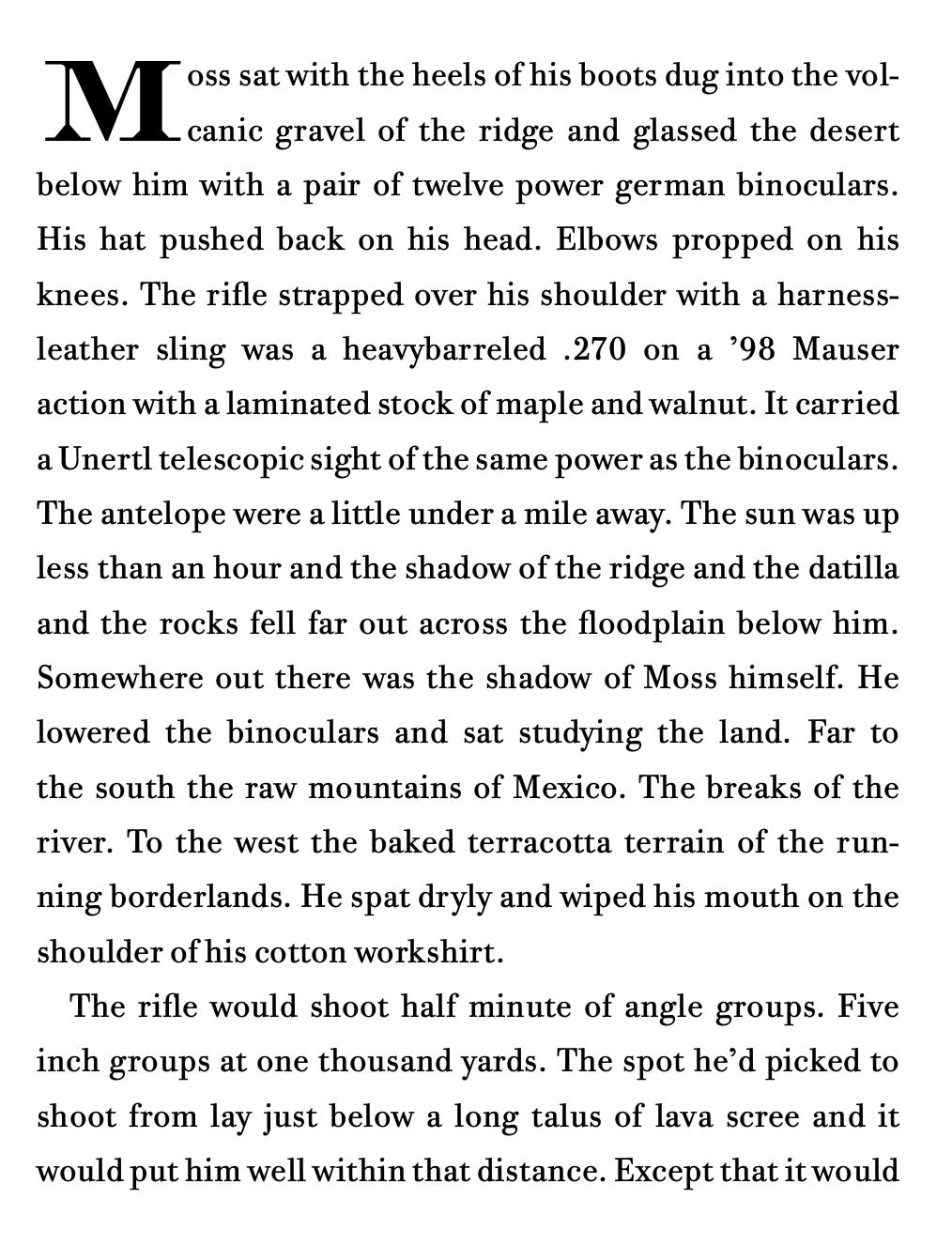
Wake for Susan is quite unMcCarthyesque in its sentimentality but its opening bears an uncanny resemblance to one of the first scenes in No Country for Old Men (where Moss aims at and misses an antelope). And like in NCOM the protagonist is named in the first paragraph:
Now compare with NCOM’s incipit, 46 years later:
A Drowning Incident
He had no tears, only a great hollow feeling which even as he sat there gave way to a slow mounting sense of outrage.
A Drowning Incident revisits the cliché childhood lie (”They [the pups] had gone to a new home last week.”) The prose is again far from McCarthy’s more mature texts, with overwritten sentences (like “The spider fled her victim to the dark recesses of the musty shaft trailing a thin string of spittle which hung in mucous loops among the strands of the web”) and unfortunate adverbs (as in “turning weightlessly in the slow water. He watched uncomprehendingly“) that the mature McCarthy would have killed.
But many elements prefigure his future style and themes:
The rural violence without moral or social commentary (Child of God is an obvious descendant.)
The religion analogies (“as if performing some last rite.“)
Describing things negatively, as what they are not (“a dimensionless wall”).
A nameless character, like "the Kid” in Blood Meridian or the boy in The Road.
Bounty & The Dark Waters
He published these two stories five years after A Drowning Incident. It’s a clear jump in quality and maturity, particularly in TDW.
The Dark Waters
In TDW a boy (“the boy”) and a man (“the man,” which we discover is named Sylder after a third of the text) go night hunting with hounds in the Tennessee woods. The boy jumps in a creek to save a dog from drowning, they track a raccoon, and apart from that little happens. It reads like an exercise as the prelude to a longer story. And indeed the character Sylder appears in The Orchard Keeper, McCarthy's first novel published the same year as TDW.
This excerpt striked me as a combination of Suttree and The Road, for its semantic fields and pair of characters:
“Lady’s sharp trail-call still broke excitedly off to their right. They moved out under the dark trees, through a stand of young cedars gathered in a clearing, vespertine figures, rotund and druidical in their black solemnity. When the man reached the far side, the woods again, he stopped, and the boy caught up with him.”
TDW also introduces the speechmarkless, minimalist, colloquial dialogues interleaved with narration that confuse so many readers:
“The boy looked up at him. Cool enough, he said.
The clothes had begun to steam, looking like some esoteric game quartered and smoking on the spit.
Then he said, What’d you do with the coon?
Coon?
Yeah. The coon.
Goddamn, the boy said, I never saw the coon.”
Bounty
Again, Bounty has barely a plot: an unnamed boy (“the boy”) kills a hawk then goes to Knoxville's courthouse to collect the government bounty on it. He wanders the city's market with his dollar before going into a hardware store to buy a trap.
We notice again dialogues interleaved in narrative paragraphs, as in (and note the “Thisn’s”):
“The man took the signed paper and handed him the other one, the carbon. Thisn’s your copy, he told him. The boy took it and folded it, then took the dollar from his watchpocket and smoothed it on the counter. The man took the dollar and rang it up in the register. Wait till I get you a poke, he said.”
The following scene reminded me of Flannery O’Connor’s Wise Blood, its blind preacher, and the main protagonist Hazel Motes’ grotesque Church Without Christ:
“On the corner a man was screaming incoherently and brandishing a tattered Bible. Next him stood an old woman strapped into an accordion, mute and patient as a draft horse. He crossed the street behind the half-circle of spectators.”
Wise Blood was published in 1952 so I’d wager it’s no coincidence. O’Connor’s Southern gothic, Faulknerian style could have been an influence, but we have no evidence he read it.
But the best part of Bounty is its opening paragraph, which I’ll let you read.
I’ll write about the next eras in the next posts. By the time his first novel appeared in 1965 (The Orchard Keeper), Charles McCarthy had become Cormac.
Era 1: The Southern Gothic years
The Orchard Keeper
Outer Dark
Child of God
Suttree
Era 2: Blood Meridian
Era 3: The Border Trilogy
All the Pretty Horses
The Crossing
Cities of the Plain