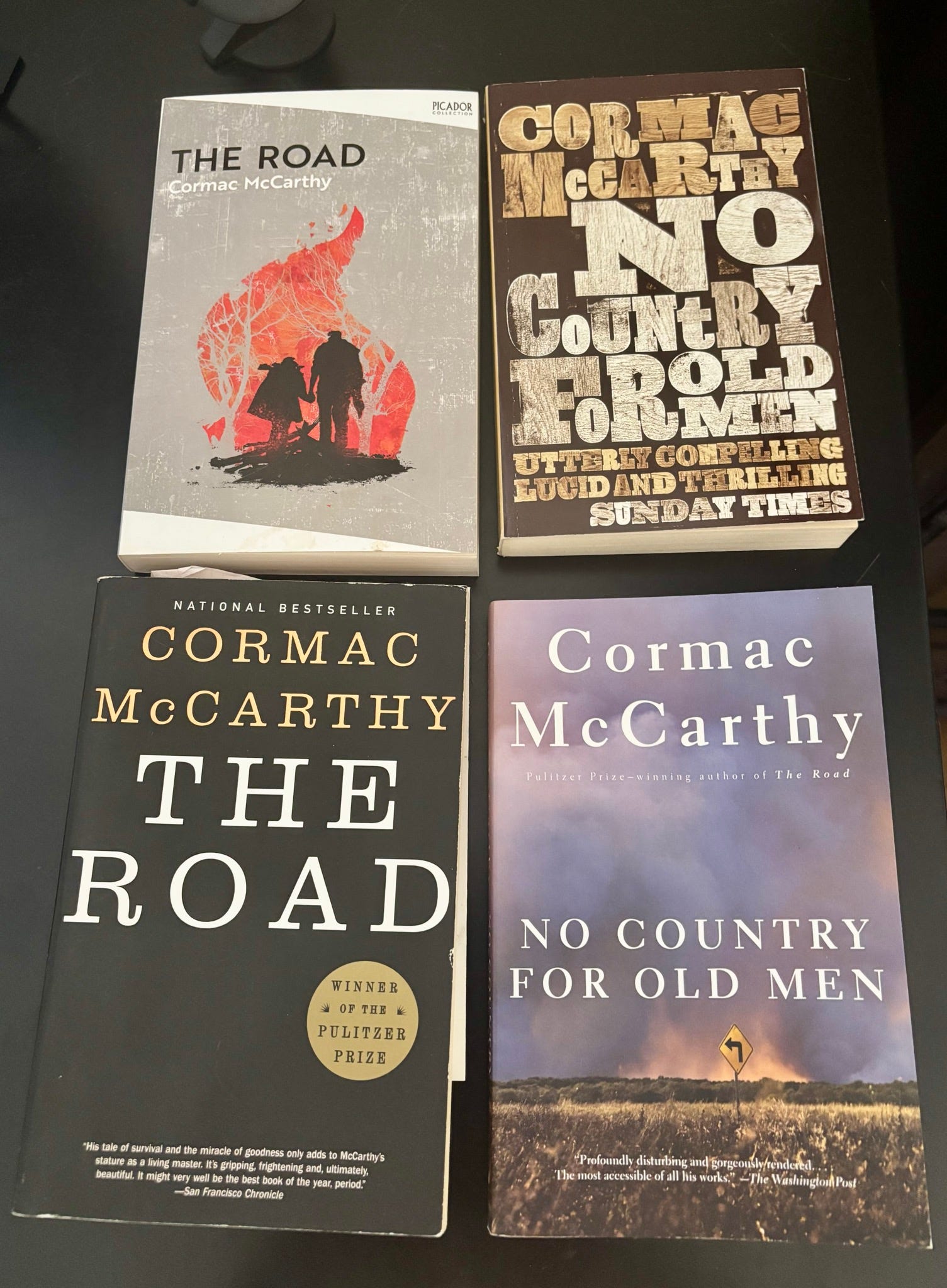
No Country for Old Men (2005) and The Road (2006) are by far McCarthy’s most famous books. Both are stories of a man trying to survive and protect a loved one against evil—one evil man in NCOM and the lawlessness of a collapsed society in The Road. The books don’t only owe their popularity to their literary merit, but to their accessibility, film adaptations (mainly for NCOM), and promotion in general media, like when the author of Blood Meridian sat for an interview with Oprah Winfrey:
McCarthy was unfamiliar with the exercise and its trivial questions but he did his best to respond respectfully and thoughtfully:
How do you know when it’s time to let it go, how do you know when the book is set, you’re done?
You just know, you told the story and that’s it. (…) The same thing that tells you what to write tells you when to stop writing it.
Another hilarious part is when he mentions John Nash:
(…) he dreamt he was having dinner with John Nash.
John Nash?
Yeah everybody knows John Nash because there was a film made a about him, A Beautiful Mind
Uh-huh
In that same excerpt, he loses the poor Oprah when he talks about the role of subsconcious in language and communication. The relevant concept is in fact the unconscious rather the subsconcious, but she didn’t notice, instead interjecting “it’s that brain thing again”, and unconvincingly commenting that she loves” the “thought” of subconscious being older than language. Interestingly, subunconscioue and language is a topic he wrote about much later in the only essay he ever published, the 2017 Kekulé Problem:
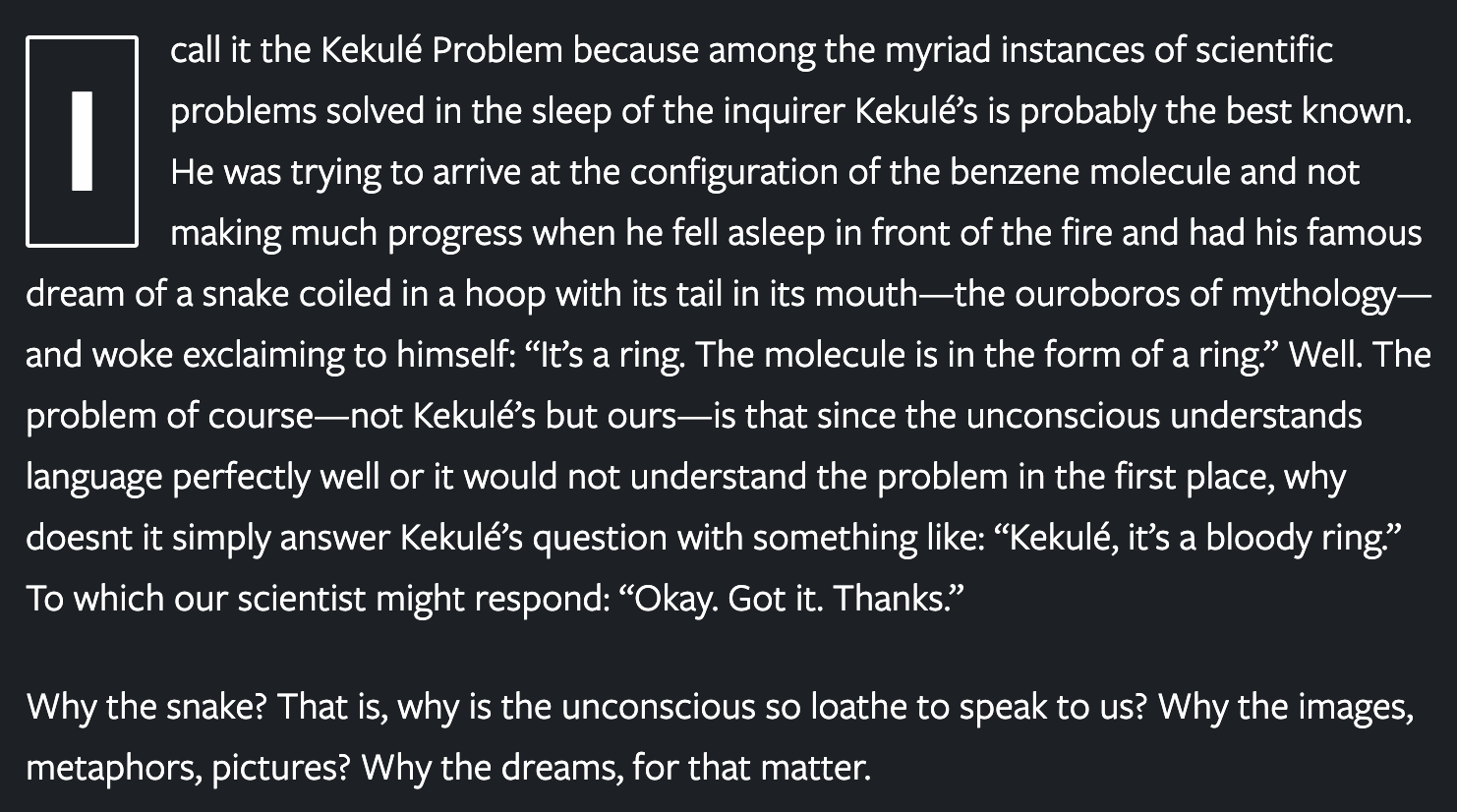
Why the snake? Some anthropologists allegedly witnessed ayahuasca-drinking shamans dreaming of snakes whereas they lived in snakeless places—like Hawaii—and concluded that they were a representation of the DNA’s double helix:
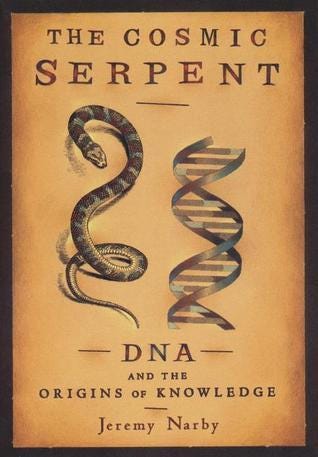
That theory later inspired the late French sci-fi writer Maurice Dantec, in his ambitious but very confused novel Babylon Babies,
But back to McCarthy’s books:
No Country for Old Men (2005)
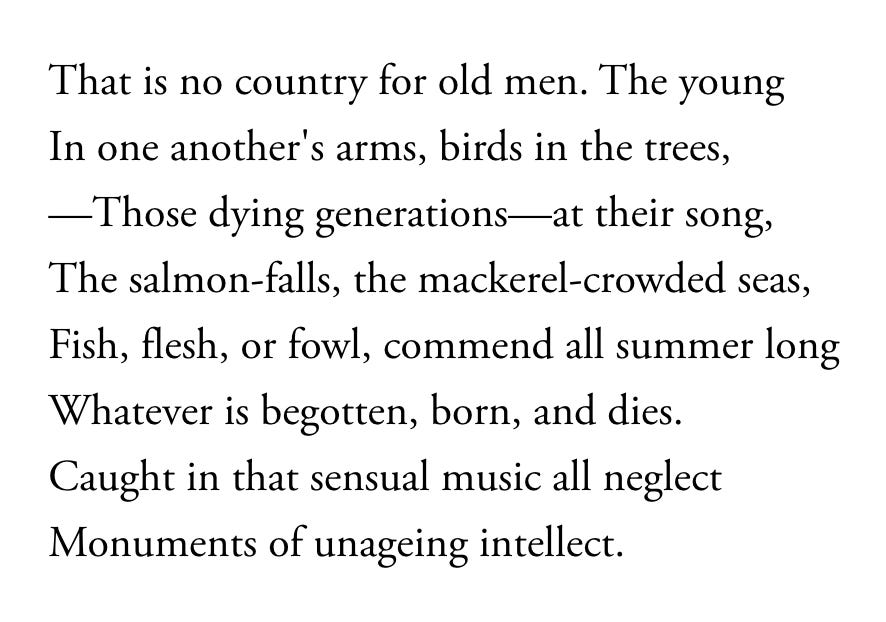
The title comes from the opening line of Yeats’s 1926 poem Sailing to Byzantium. As far as I know, McCarthy never explicitly confirmed the reference, but coincidence seems implausible; even more so when the poem is strikingly McCarthyesque, and arguably fits The Road even better than NCOM:
The first version of NCOM was a screenplay that, like Cities of the Plains, failed to convince Hollywood filmmakers. McCarthy then turned it into a novel that the Coen brothers adapted into one of the greatest films. The unverified story is that the Coens somehow came across NCOM before its publication, whether through the screenplay of the novel. A lot has already been written about the film, the differences from the novel, Javier Bardem’s genius cast as Chigurh, etc. If you haven't read the book, read it first, then watch the film.
The screenplay’s legacy is unmistakable in NCOM’s highly cinematic prose; McCarthy lingers on minute gestures and actions and writes detailed descriptions of landscapes and plants. Consider for example this passage, where Moss hides a bag of money in a motel room’s air duct:
It sometimes get even more terse, here with only succinct fragments:

(Okay, you could argue that there’s similar dry camera-eye descriptive passages in many of his previous books but I think it’s more prominent in NCOM; it also lacks a lot of content that wouldn’t serve a screenplay.)
Like The Passenger alternates between chapters following Bobby Western and italicized chapters about his sister Alicia and her visions, NCOM alternates between the main story, told in a mostly omniscient third person, and Sheriff Bell's italicized first-person monologues (roughly 10 to 15% of the novel.) Bell's chapters are written retrospectively, post the novel’s events, reflecting on his career and on his inability to understand let alone confront what Chigurh represents.
Although NCOM initially presents itself as plot-driven, I think it's ultimately a (Bell-)character-driven novel. The thriller plot is there to illuminate (actually, to darken) the sheriff’s worldview and the way it collapses under the weight of the violence he witnesses. So let's look at the characters, in reverse order of appearance in the novel.
Moss
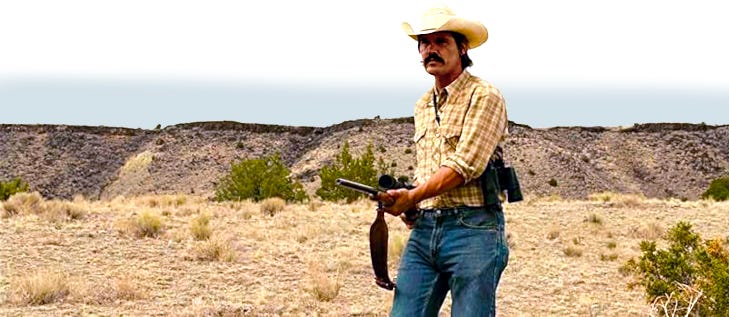
Set in 1980, NCOM opens with welder Llewelyn Moss hunting antelopes in the Texas desert, foreshadowing the novel's predator–prey dynamic. He stumbles upon the aftermath of a drug deal gone wrong where he finds a bag full of cash. He takes it back to the trailer he shares with his wife, nineteen-year-old Carla Jean.
At the crime scene, one wounded Mexican man, barely alive in an SUV, begged him for water but Moss had none. During the night, he drives back to the scene with a jerrycan of water, but predictably it doesn’t go as planned: the man is dead, other men are there and they’ve very much alive:
That's the novel's premise: an act of compassion and/or guilt that backfires, turning Moss into prey hunted by the dopedealers for their money back, facing the irrevocable consequences of his decisions, a predicament common to Cities of the Plain and The Counselor. That’s close to a cliché start, but two characters elevate the novel beyond airport literature:
Chigurh
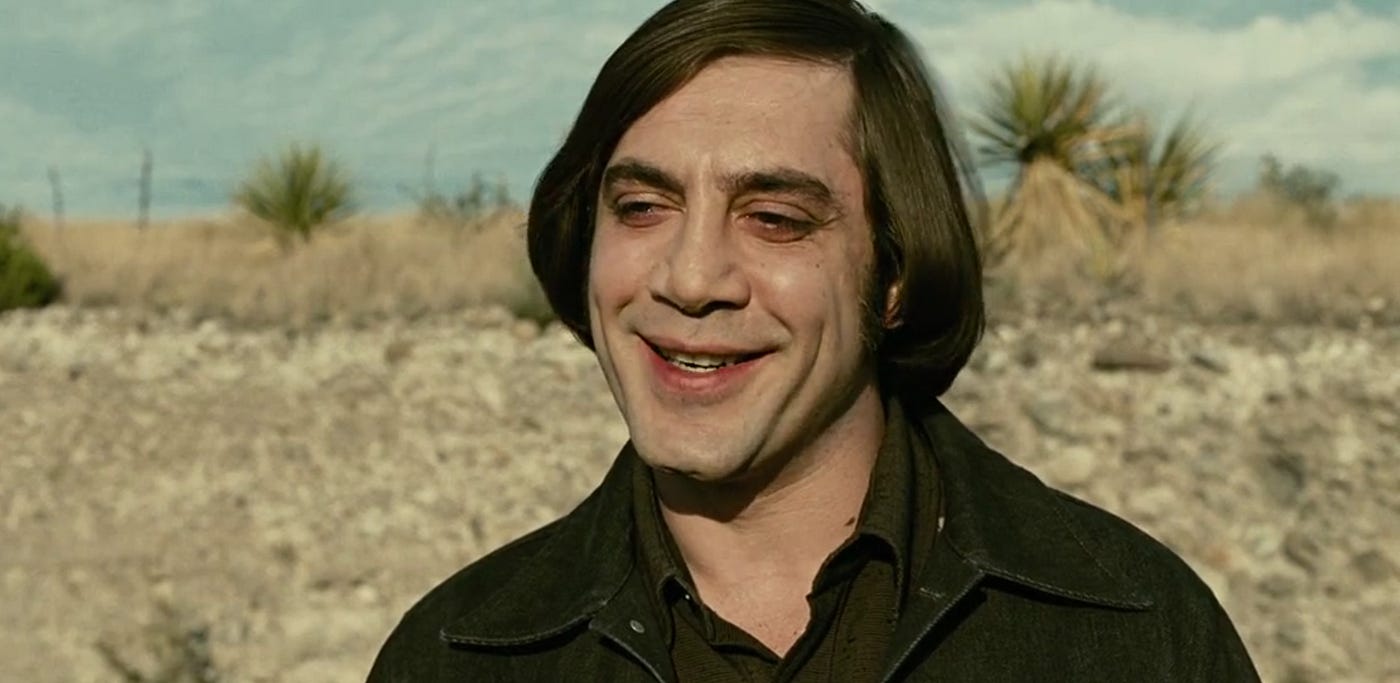
Anton Chigurh is the psychopathic, placid hitman that at the start of the novel carries a captive bolt pistol (as used to kill cattle) and its air tank (the size of a scuba tank) and kills people with it in a way that leaves a hole in their body but without a bullet staying inside or going through, which confuses the police investigating his murders. The man has no documented backstory or geographical provenance. Even the name “Chigurh” seems made-up by McCarthy (there’s a theory that it’s a pun with “chigger”.)
Chigurh is a evil man, but principled man, with his personal concept of accountability and an unalterable acceptance of fate’s unpredictability, whose absurdity is best seen in the coin toss scene. He’s otherwise a fairly one-dimensional type, with little interest in life's pleasures and only driven by his mission and his survival. He kills by necessity or perceived necessity as per his logic, but he appears to neither enjoy nor dislike the murders. So he’s not very empathetic, but he’s not really sadistic either, he just doesn't care, a nihilist.
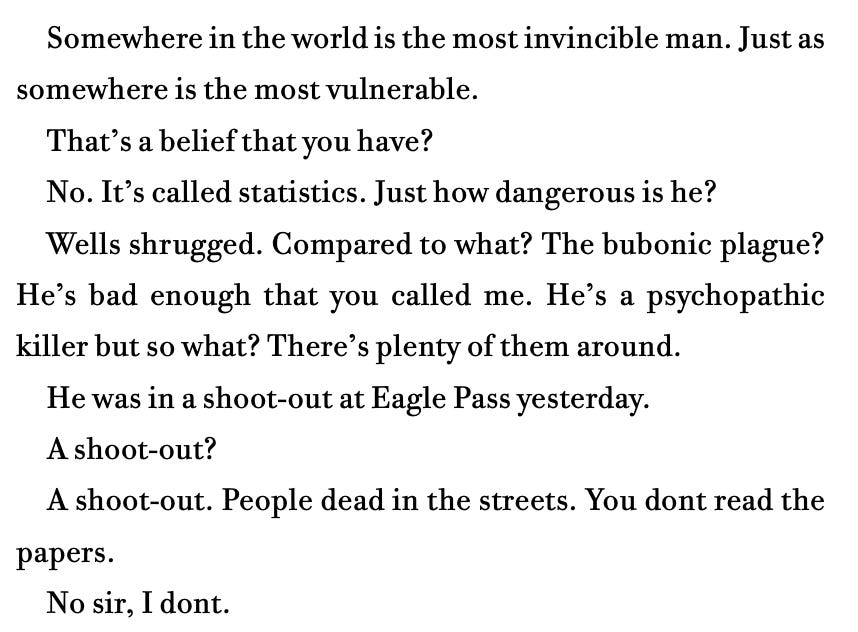
McCarthy clearly defines him as the absolute evil, or Satan’s incarnation. When his former boss tries to get another man to stop him, he refers to him as an invincible man:
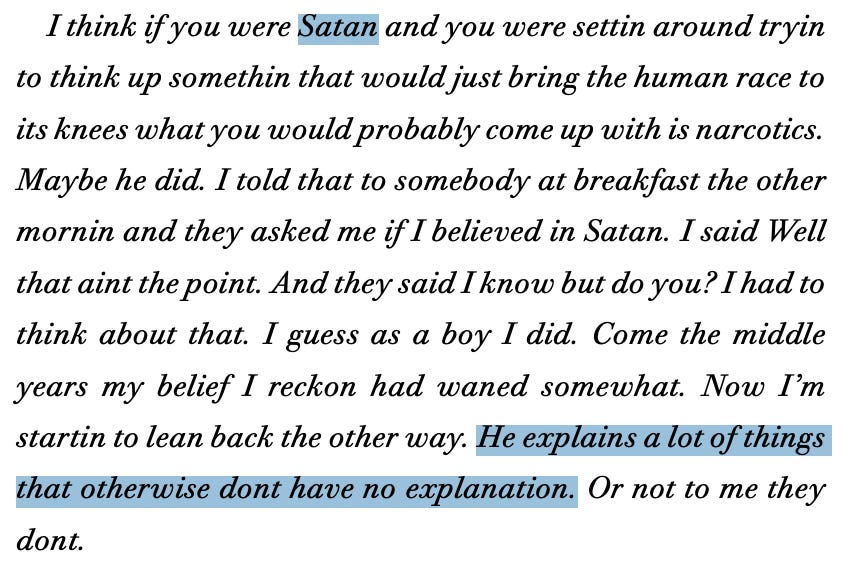
Later in the novel, McCarthy—via Sheriff Bell’s words—indirectly points to Chigurh as an incarnation of Satan:
And on the very first page of the novel, Bell calls him a “prophet of destruction”:
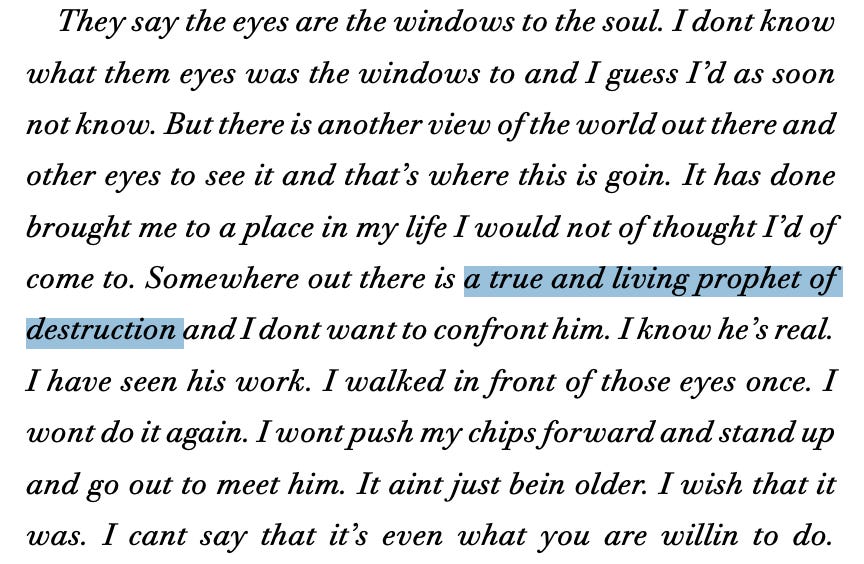
What transpires here is that Chigurh (and everything he represents and embodies) is a catalyst of Bell’s retirement as a sheriff, and a literary device supporting the main book’s story, which in my opinon is Bell’s—when Moss and Chigurh’s story is the parable behind it.
Bell
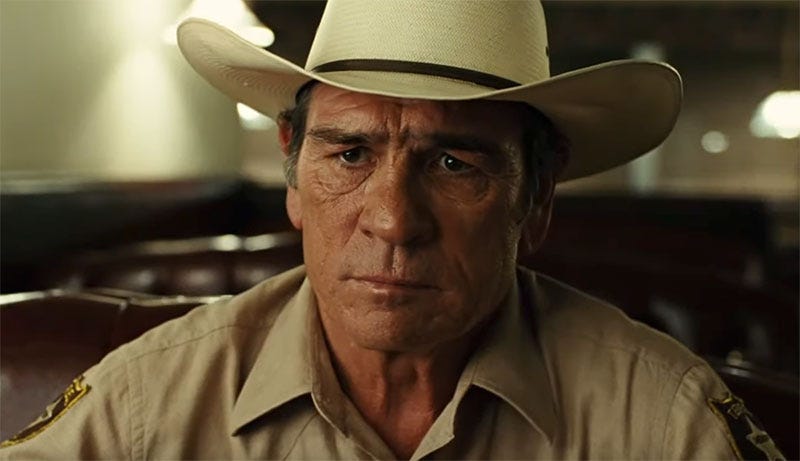
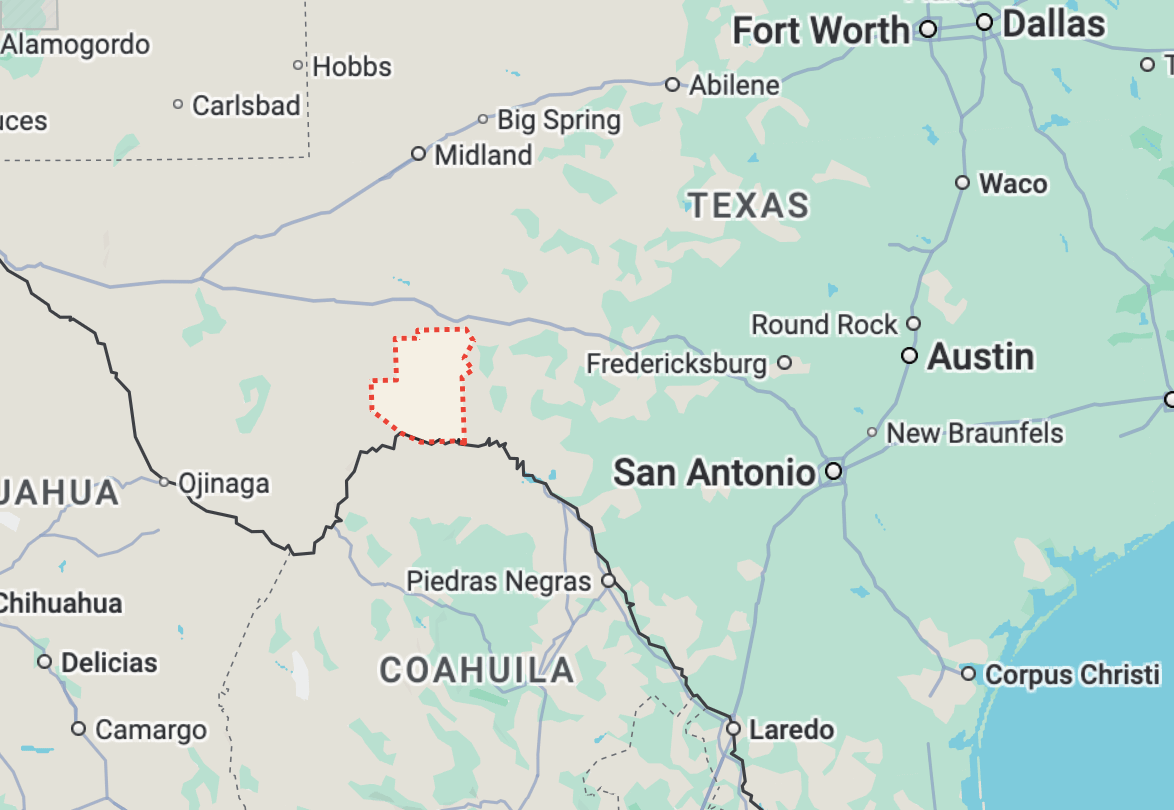
Bell is both the sheriff investigating the murders surrounding Moss's discovery of the money and the narrator of the novel's italicized first-person chapters. Bell is the sheriff of Terrell County, a real Texas county, based in the county seat Sanderson (~700 inhabitants) where Moss lives in the (fictional) Desert Aire Trailer Park:
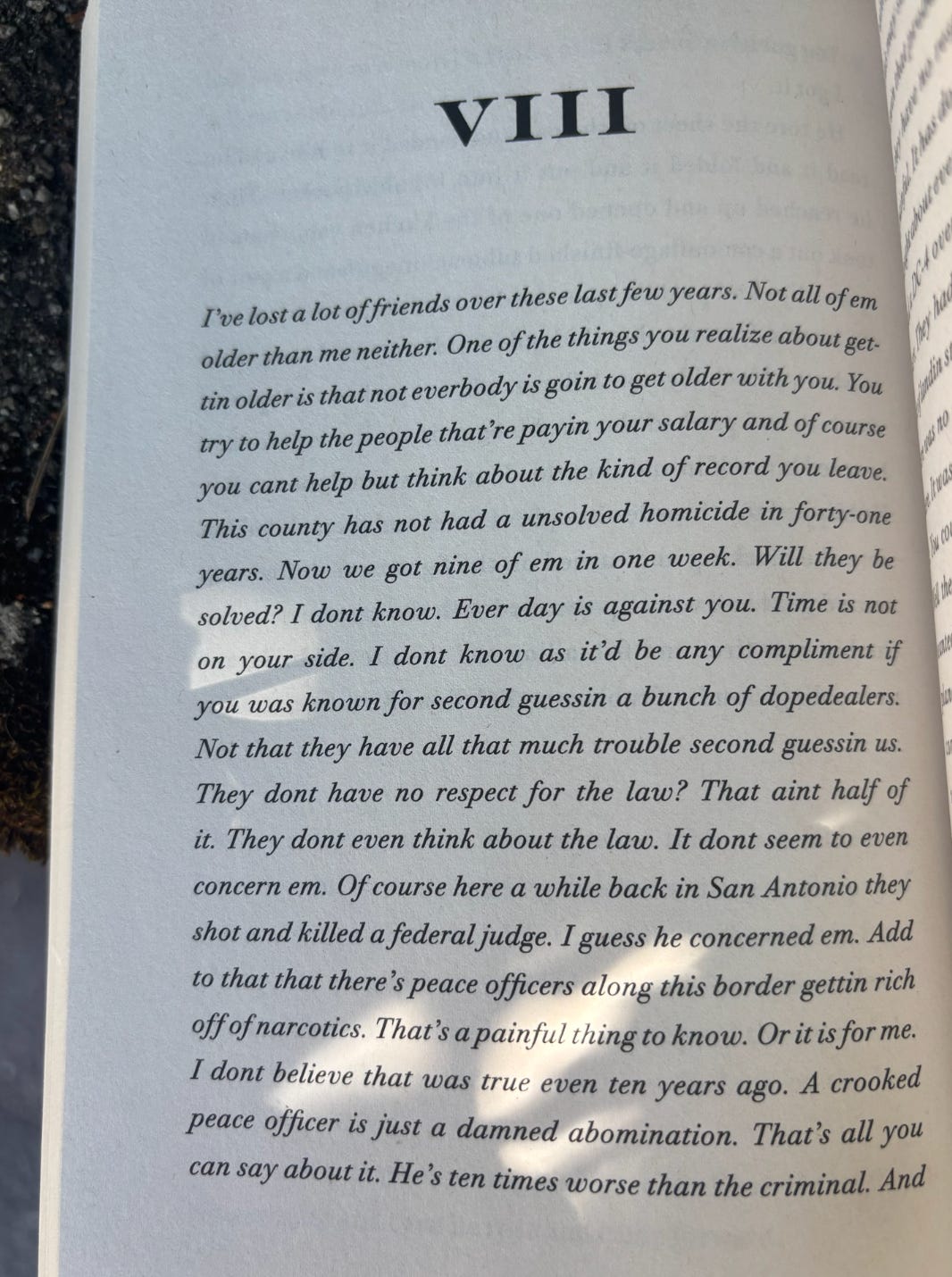
Bell's chapters are the core of the book. They're largely absent from the film, yet they're the novel's real statement: the small kernel hidden beneath the sprawling Moss-Chigurh thriller. Read superficially, Bell sounds like the grumpy old man lamenting that the world used to be better: crime is worse, people are crueler, nobody respects the law anymore, etc. It's easy to mistake him for another nostalgic sheriff reminiscing about better times.
Bell is certainly conservative, somewhat religious, and attached to an older moral order. But reducing him to the cliché of the reactionary small-town Texas sheriff misses almost everything interesting about him. He’s not blaming the times as much as he’s blaming himself, acknowledging his difficulty to cope with the times and the violence, which he’d faced early in his life when serving in WW2. Reviewers are often tempted to reduce Bell to this idealist nostalgic character, though; for example, in this review by Annie Proulx in The Guardian (with my emphasis):
Good ol’ boys come in assorted flavours, from the bullying top dog to those who, through an in-built sense of fairness and justice founded on Christian values and local traditions, earn the affection of the common people. Bell is the second kind of good old boy, but he has come to think of bygone days as idyllic. (He obviously has not read McCarthy’s earlier books.)
That reading would make more sense if NCOM existed in isolation, but it doesn’t. McCarthy’s earlier novels leave little doubt about his view of violence. Blood Meridian presents it not as a product of modern society or failed politics but as something intrinsic to human nature. Bell isn’t mourning the arrival of evil. He’s mourning his inability to keep pace with it. His exhaustion is less ideological than professional: the fatigue of a border county sheriff confronting forces beyond the scale of his county. He’s not blaming the government or anyone else than him.
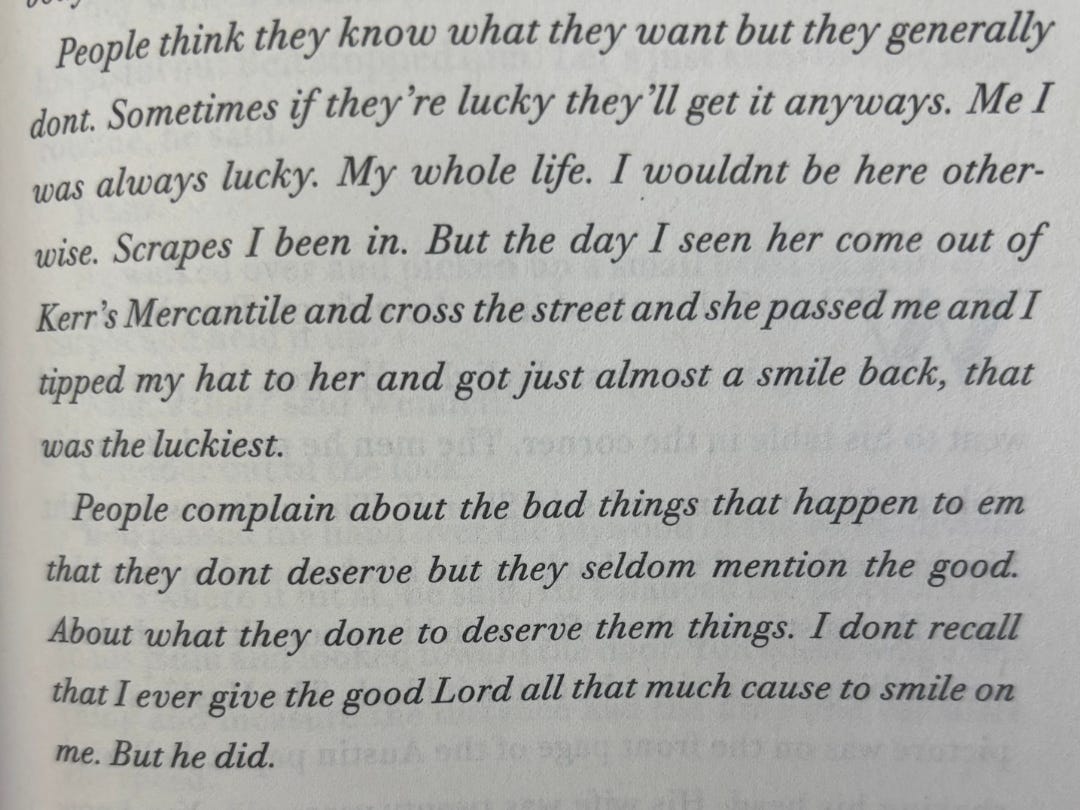
A reason why Bell isn’t bitter and depressed is that he’s an empathetic man, with an overall positive outlook on life in general, happily married and grateful for it:
Bell's deepest wound, however, predates Chigurh. Near the end of the novel he confesses to the reader the guilt he’s carried since WWII, where he received a Bronze Star he believes was unwarranted. Becoming sheriff was in part an attempt to repay a debt he feels he still owes. The Coens’ film makes up for the relative absence of Bell in the film by ending with this encounter and a scene with Loretta, Bell’s wife, which isn’t in the book.
No Country for Old Men is a great title, but the book could also have been called Sheriff Bell’s Confessions, both in the ordinary sense of confessing his failures and guilt, and in the Augustinian sense of an introspective meditation on memory and morality and time.
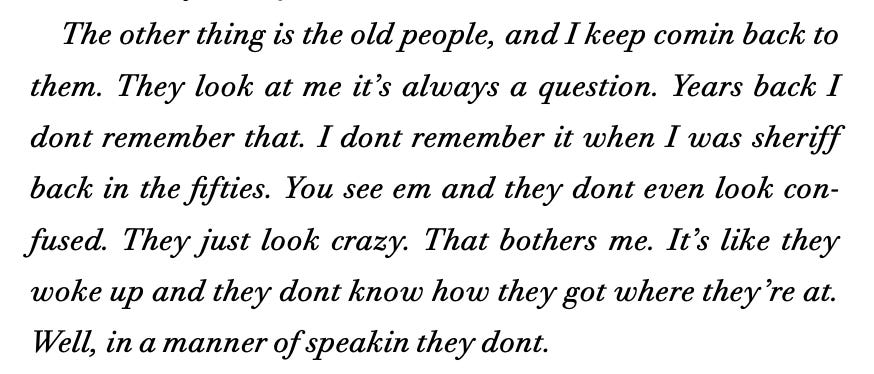
Bell’s monologues repeatedly return to the same universal, existential questions that philosophers have always wrestled with: guilt, memory, the burden of time, and whether a human life can ever truly be understood in retrospect. This reminded me most of Saint Augustines’ Confessions, wherein most of Book XI is largely about the nature of time, with several parts that Sheriff Bell wouldn’t argue with; Who shall hold the heart of man, that it may stand still, and see how eternity ever still-standing, neither past nor to come, uttereth the times past and to come? (Book XI). Augustines’ Confessions also include a part about “stage plays”, or fictional/imagined stories in general, which I find fitting to quote in its entirety:
Stage-plays also carried me away, full of images of my miseries, and of fuel to my fire. Why is it, that man desires to be made sad, beholding doleful and tragical things, which yet himself would no means suffer? yet he desires as a spectator to feel sorrow at them, and this very sorrow is his pleasure. What is this but a miserable madness? for a man is the more affected with these actions, the less free he is from such affections. Howsoever, when he suffers in his own person, it uses to be styled misery: when he compassionates others, then it is mercy. But what sort of compassion is this for feigned and scenical passions? for the auditor is not called on to relieve, but only to grieve: and he applauds the actor of these fictions the more, the more he grieves. And if the calamities of those persons (whether of old times, or mere fiction) be so acted, that the spectator is not moved to tears, he goes away disgusted and criticising; but if he be moved to passion, he stays intent, and weeps for joy.
May you be moved by McCarthy's book as much as I was.
The Road (2006)
The Road is set in what is usually called a post-apocalyptic world, where society, the rule of law, and nearly all infrastructure have vanished. Most human beings seem to have vanished too. Among the survivors are the novel’s unnamed protagonists: a father, “the man,” and his son, “the child,” who calls him Papa. They walk south through a dead America, pushing a shopping cart loaded with blankets and their few remaining supplies.
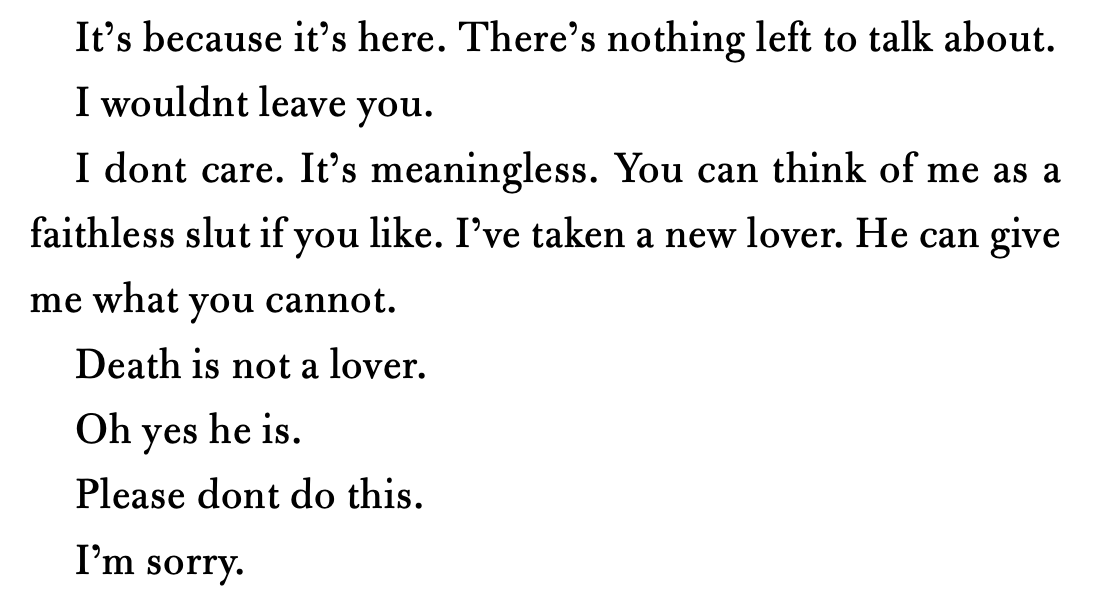
McCarthy dedicated The Road “For John Francis McCarthy,” his son, born in 1999. It shows. The Road is the story of the man and the child. The mother is gone; she chose death:
I haven’t seen the film adaptation. I’ve heard it’s good but not great. But the main reason is that I don’t want it to overwrite my own image of the characters and their world before I reread the novel.
I must also mention the excellent graphic novel adaptation, by French artist Manu Larcenet.
Ashes
Unlike NCOM, The Road has almost no plot to speak of. Some devastating event has occurred but its precise nature is unexplained. We know only this:
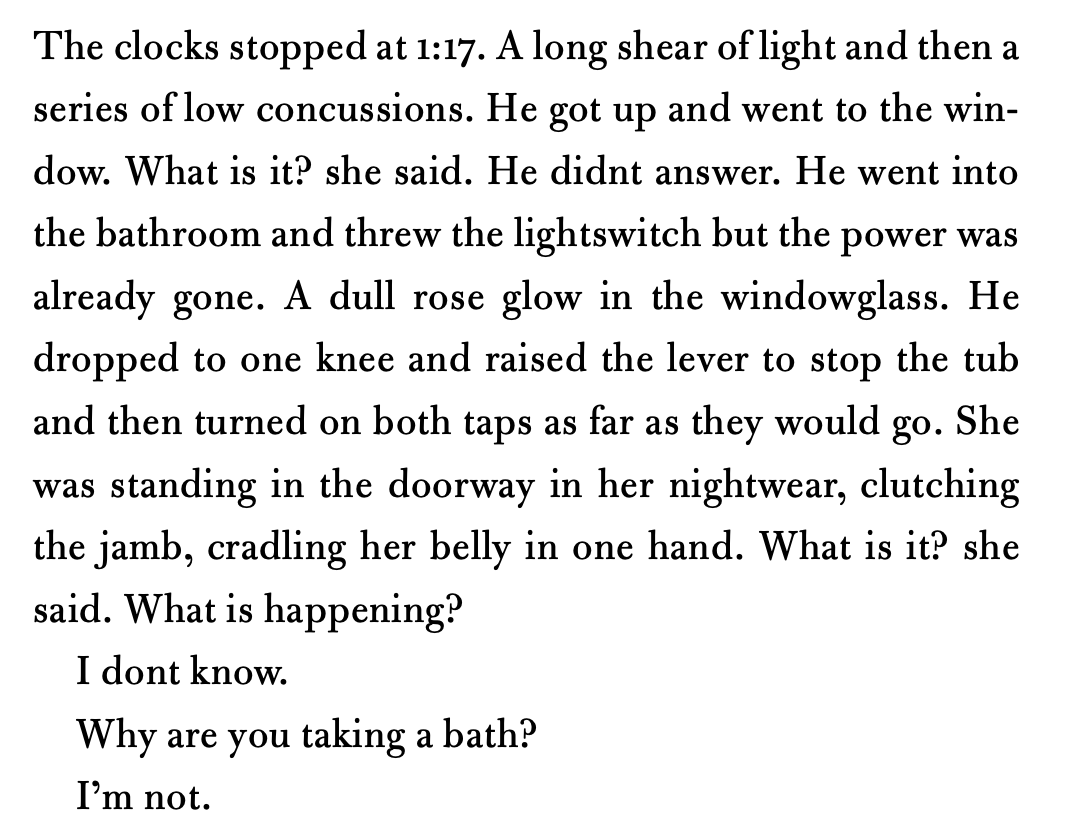
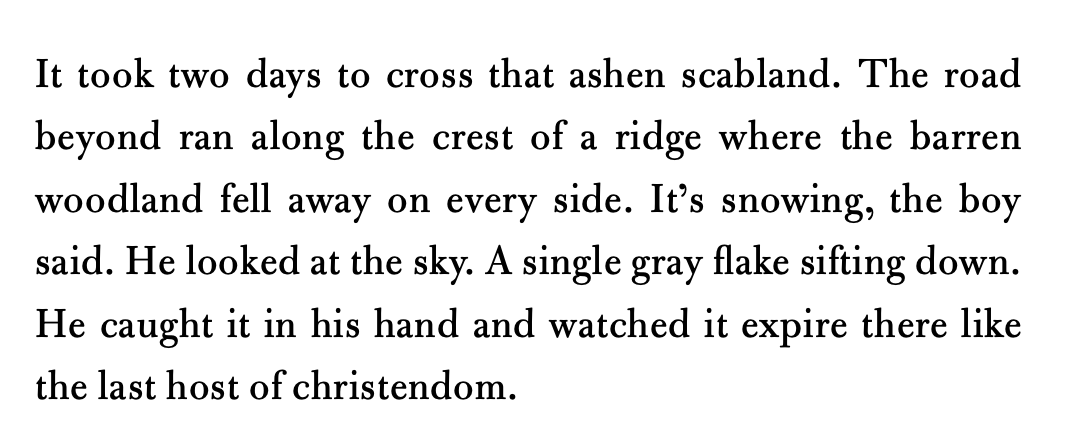
Whatever happened has left the world, or perhaps only the country or the region, in ashes, literally. “I have become like dust and ashes” (Job 30:19). Ash recurs throughout the novel, carrying with it the language of mourning, mortality, penance, and the remains of a world that once was.
Like here:

And here, where a single flake becomes “the last host of christendom”:
The Road begins with destruction and it ends with creation.
Death
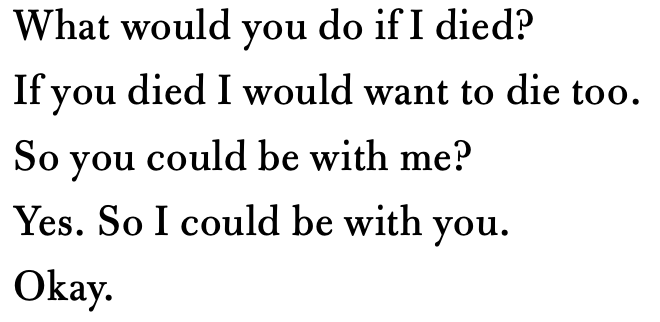
Death is omnipresent in The Road, often appearing most plainly in the child’s questions:
Most people have already died. Those who remain seem unlikely to survive for long:


Death is no longer an exceptional event but the ordinary background of the protagonists, something the child must repeatedly ask about because it governs every decision they make.
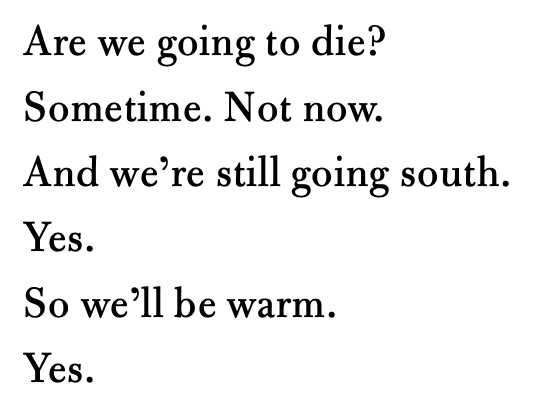
But The Road isn’t devoid of hope; hope for warmth, food, shelter, survival:
God
Even God seems to have vanished. Or has he?
The world appears abandoned not only by civilization but by divine order and any form of grace. Yet religious language persists: ashes, hosts, prophets, fire, goodness, judgment. God may be absent, but the need to speak of him survives.
One day the man and the child meet an old man who calls himself Ely, perhaps an echo of the prophet Elijah:
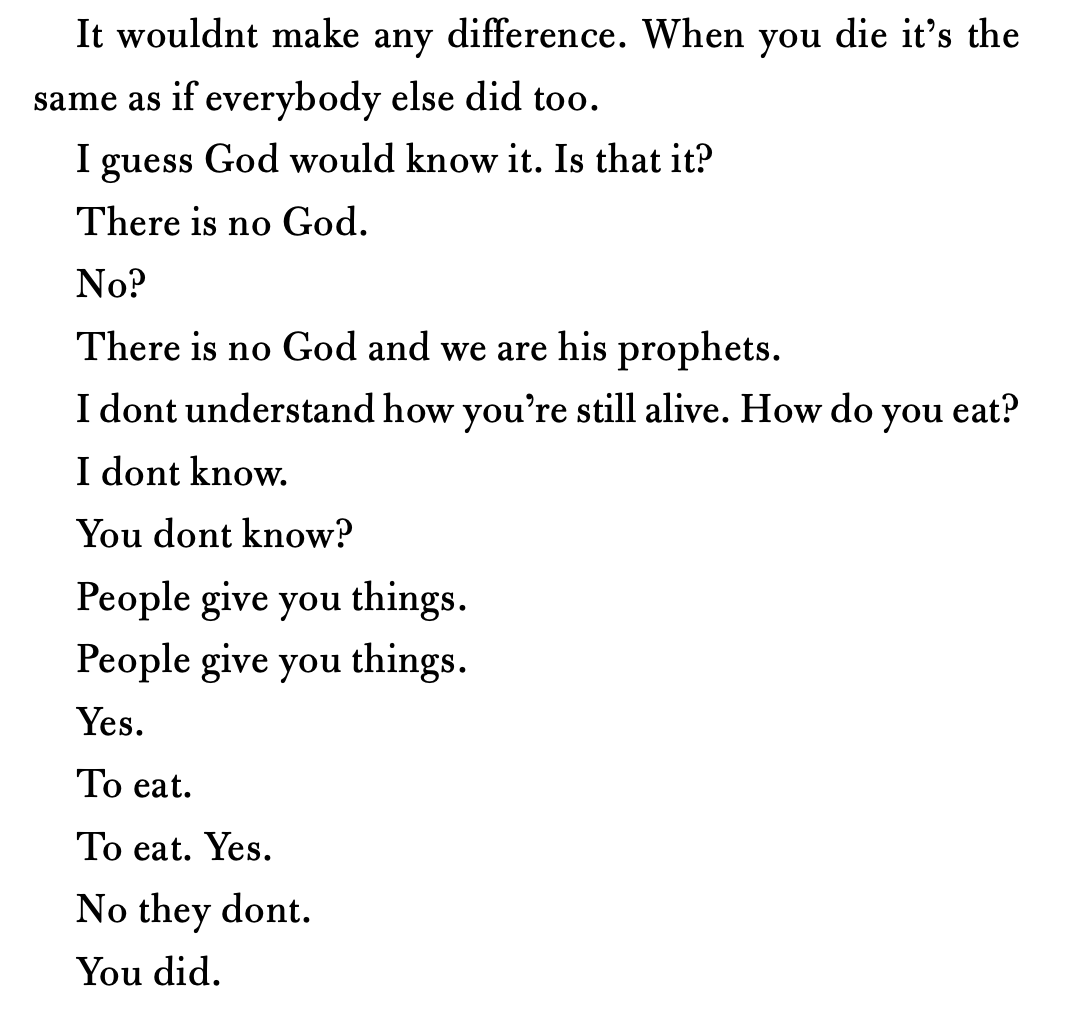
“There is no God and we are his prophets” is one of a McCarthy’s characteristic paradoxes. It echoes the rabbinic idea of a God who entrusts men with the work of judgment rather than intervening forever from heaven, as in the Talmudic story of the Oven of Akhnai. Ely gives that idea its post-apocalyptic form: God may still be there, but men remain accountable for the truth.
The fire
The child will live. He is the one who resists the man’s violence, who’s troubled by the suffering of strangers, and who insists that being one of the “good guys” must mean more than just surviving. He is also the one who must “carry the fire”:
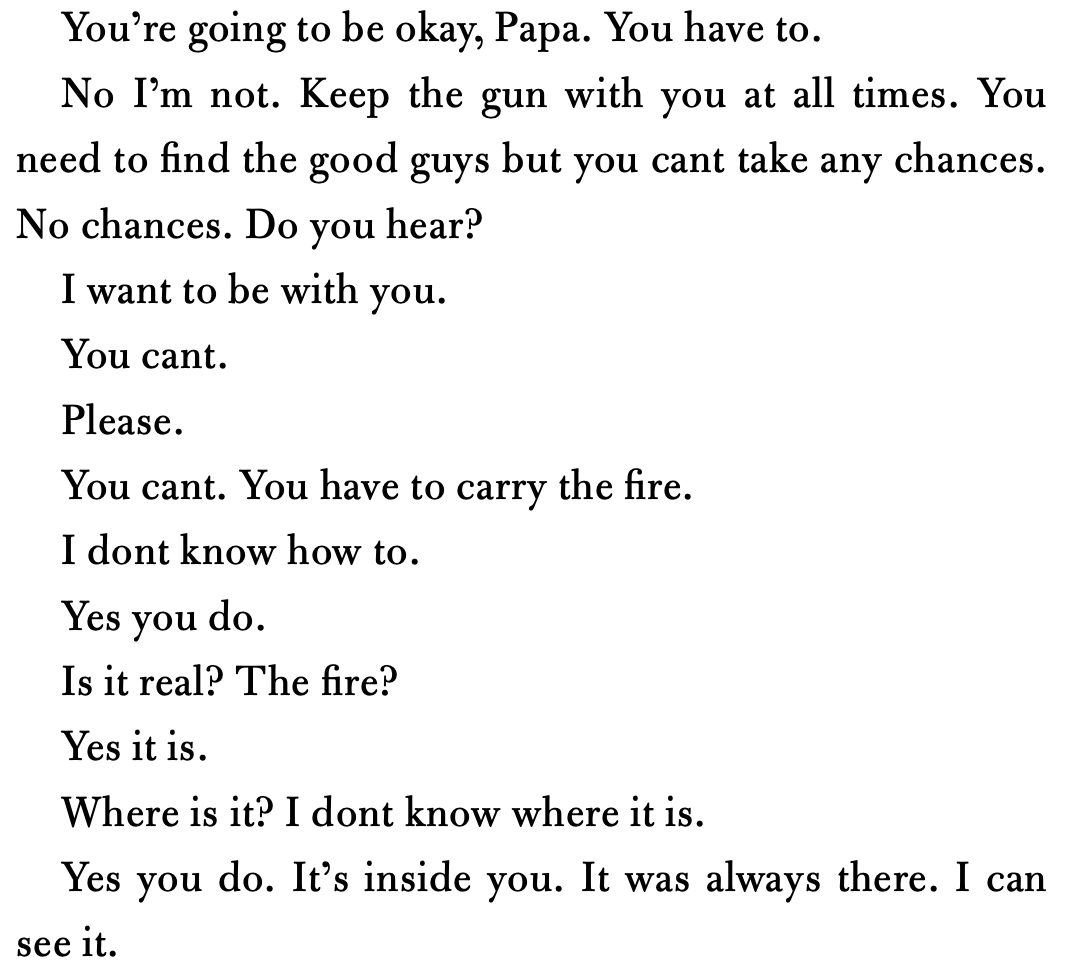
The fire is life, conscience, innocence, memory, love, and perhaps the last surviving fragment of the sacred. The father protects the child’s body, but the child protects the meaning of their survival. Without him, the book would be as boring at the last Mad Max films.
The end
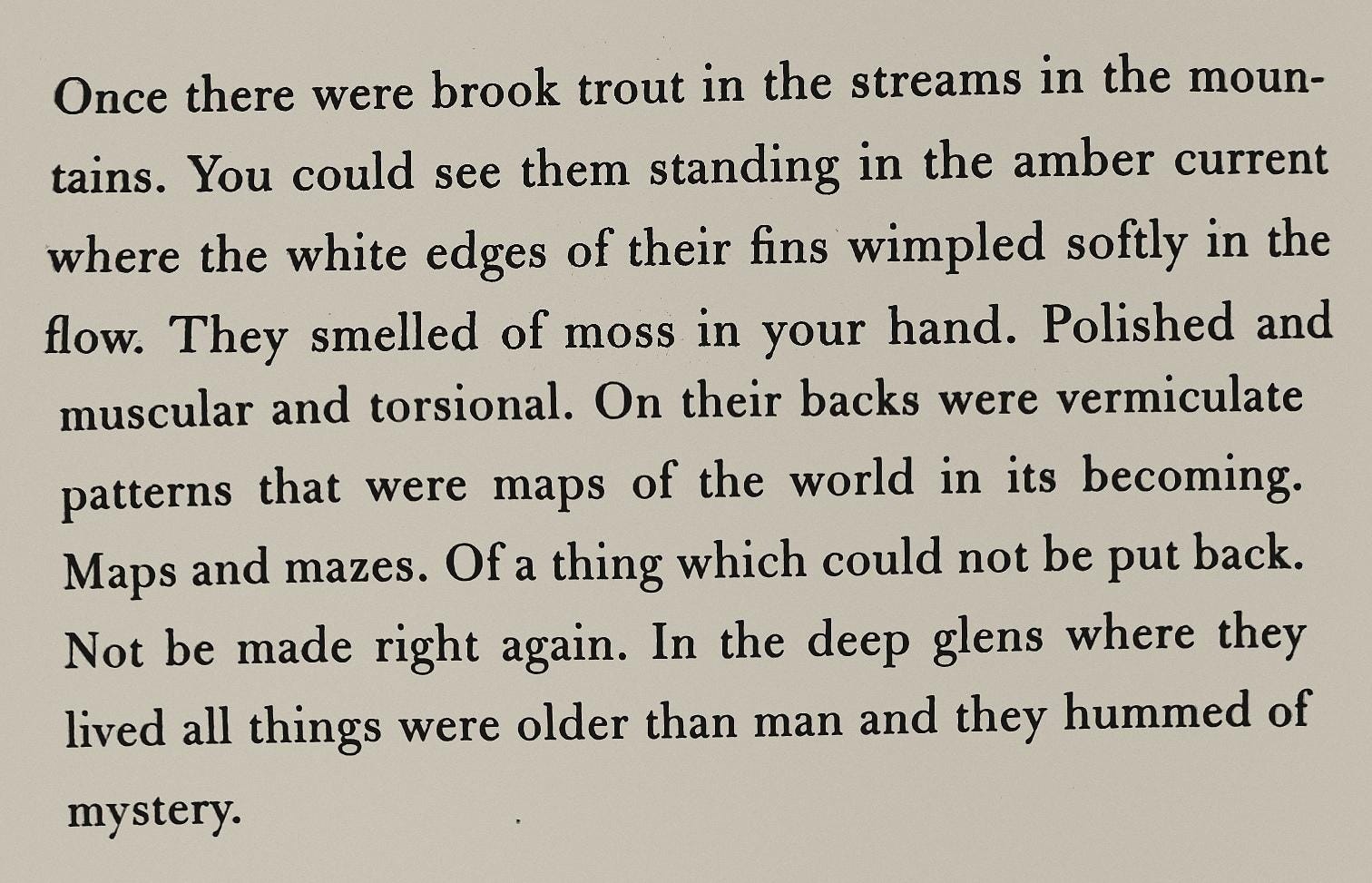
The final paragraph of the novel may be the finest ending McCarthy ever wrote:
Featured image: The Great Day of His Wrath, by John Martin.